Review of Sun Yung Shin’s Heart Eater, A Memoir of Immigration, Belonging, and How We Find Ourselves in Language
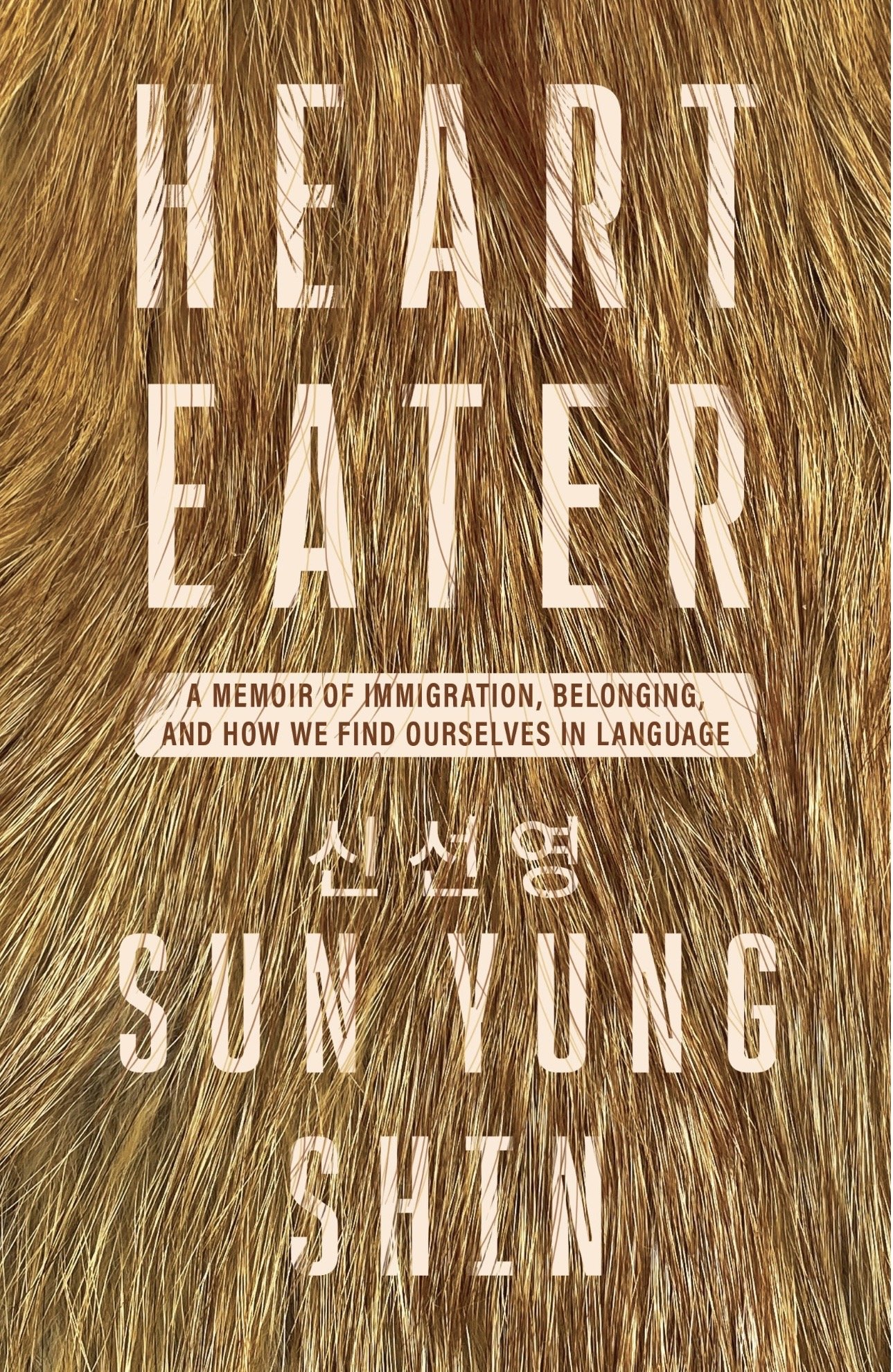
Heart Eater by Sun Yung Shin
Heart Eater is available for pre-order here https://www.sunyungshin.com/
Sun Yung Shin’s memoir Heart Eater explores different facets of belonging, weaving together fragmented essays composed of literary analysis, the author’s personal history, and the cultural complexities of an American identity. As a Korean adoptee into a white family in Chicago, Shin excavates her own life like a detective. Multiple chapters include documents from the author’s personal archive. Childhood photos, naturalization documents, adoption agency files, and correspondence from her adoptive family create a spiraling paper trail. These physical documents are both a connecting thread between the different essays and a visual reflection of the memoir’s collage form.
Shin navigates her search with lyric prose and wry humor; her essays unflinchingly expose the cognitive dissonance of existing in America as an immigrant and minority. As an adoptee differing physically from her new family, Shin cannot escape her own “otherness,” even at home among people she loves:
“The people in your family are not your mirrors—you can’t look at your mother and see your eyes or your smile; you can’t look at your father and see your skin color or hair texture. You don’t have the same hands as a sibling.”
Shin was brought to the US from South Korea at the age of two; it is unclear if her name or birthdate was given by the Holt International Adoption Agency or were hers originally. The circumstances of her becoming a ward of the state were also murky. Shin reveals many South Korean transnational adoptions between the 1970s and early 2000s involved a significant level of corruption, stemming from both the South Korean government and the adoption agencies themselves.
Shin does not shy away from the complex reasons behind these adoptions: Korea’s civil war and US intervention, financial and social incentives, and outright fraud resulted in over 200,000 children sent overseas. The resulting displacement and transience she experienced recur as themes throughout the work:
“Being part of a second, adoptive, family means you know that families can be deconstructed, constructed, and further deconstructed. Having a second or third name means you can be decoupled from language at any time, and that you have to hold onto names lightly. Being an adoptee is a lifelong lesson in impermanence.”
Shin’s memoir mirrors this reconstruction, dismantling and considering identity through various lenses, such as immigrant and citizen, adoptee and writer. Different essays focus on the effects of religion, folklore, pop culture, intergenerational trauma, and political conflicts which contributed to who she is today. Shin plays with the concept of impermanence, such as how truth morphs depending on circumstance, cultural perspective, or the interpretation of a single word. Many opposing things might be true at once, as evidenced by the author herself. Shin is both an orphan and a beloved daughter, both an American citizen and a native of Korea, and yet fully belongs to both and neither.
Shin’s perspective acts as a necessary and poignant counterpoint during America’s current time of political strife. Minorities in America have always experienced an entirely different level of rights and protections from their white counterparts. Alongside Shin, the reader dives into the underbelly of American history through her childhood discoveries of Japanese internment camps, the forced relocation of Native nations, and the pervasive narrative of white superiority in American culture. The reader experiences the America of Shin’s childhood, and the accompanying loss of innocence as her older self meditates on those discoveries.
In multiple essays, two labels emerge with relative certainty for Shin: those of immigrant and writer. Shin crafts shards of herself into a larger mosaic through her own words, the work of other writers, and the fluid nature of language itself:
“An immigrant, like language, is a shapeshifter…Individual words migrate, alphabets migrate, whole languages migrate.”
One of the most impactful moments of Shin’s lyric, vacillating truths emerges in the prose poem “Collective Note: Because We.” The piece explores the possible reasons a child might have been put up for adoption in South Korea.The powerful repetition, driving pace and the painful revelations of each contradicting line encapsulate the conflict of finding one’s own truth. The collective, referring to the thousands of affected adoptees, become a chorus of voices culminating in a storm of what-if, could-have, and might-have-been. The “truth” of why shifts with each line and ultimately remains elusive.
The memoir’s title, Heart Eater, is taken from the poem “In the Desert” by Stephen Crane. Through an in-depth analysis of Crane’s work, Shin muses on what it means to “eat one’s own heart:”
“…the immigrant writer has to be willing to take out her own metaphorical heart. No one is waiting for her words, her art. No one, or at least not a wide audience of strangers, wants her heart. She has to want it the most…. she must, again and again…grasp her heart with her own hand and hold it up…She must turn it from side to side to find the right spot, like an apple, and then take the first bite.”
Shin’s work is a powerful reminder of how storytelling constructs identity, the strength of the written word to convey perspective, and the mutability of truth. The reader is left with the lingering surety of the heart’s taste, which, while sometimes bitter, belongs wholly to oneself. In deciding who they will be, both the reader and author take the first bite.
신 선 영 Sun Yung Shin is an award-winning poet and essayist who was born in Korea, grew up in the Chicago area, and is currently based in Minneapolis. Her work has been published widely in places such as POETRY, BOMB magazine, and the 2021 Gwangju Biennale; she speaks and presents frequently. Her fifth book of poems, Six Tones of Water, an experimental work co-written with Vi Khi Nao, was published by Ricochet Editions in 2024; her four other poetry/essay collections including The Wet Hex and Unbearable Splendor are published by Coffee House Press. She is the editor of three prose anthologies, most recently What We Hunger For: Refugee and Immigrant Stories about Food and Family and is also the author of three picture books including the forthcoming Revolutions Are Made of Love: The Story of James Boggs and Grace Lee Boggs. With poet Su Hwang she co-directs Poetry Asylum in Minneapolis.
Madelynn Paz is a former Haydens Ferry Review intern and a current undergraduate student and staff member at Arizona State University