Cade Januzewski Reviews Seabeast by Rajiv Mohabir
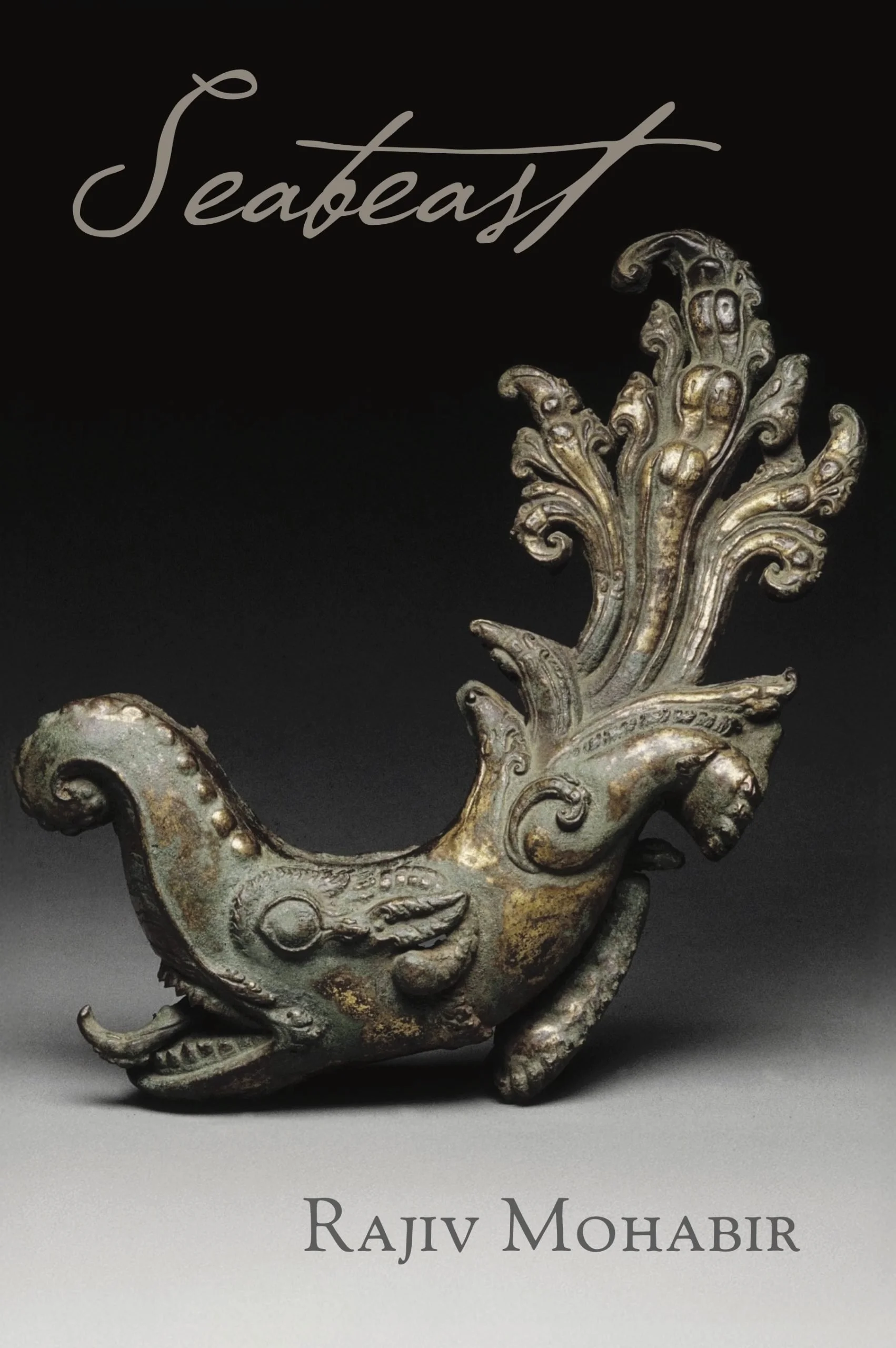
To me, Rajiv Mohabir’s Seabeast encapsulates the fluid and amorphous nature of marine life, especially whales. Whales, coming from the ocean to live on land, then evolving again to reclaim the sea as a habitat, are a great conduit to critique the rigid structure of society. The societal constructs and binaries that humans enforce act as a limitation, which Mohabir defies through his exploration of race, culture, family, love, and the environment; these concepts are not rigid, but ever-changing as he grapples with his and his family’s experiences, as well as external forces.
Mohabir titles each poem after a different marine animal: species of whales and dolphins, manatees, sea lions, and narwhals. Every title contains a companion subtitle of the scientific name of the species. I find the usage of the scientific names powerful as they demonstrate that, while each species can be scrutinized under an antiseptic lens, said species are more than isolated specimens. Instead, they, too, have a rich and unique inner world that could be examined as a sort of consciousness, like in “Peter (Odontocetiphelia),” which describes the emotional attachment between a bottlenose dolphin and his captor, Howe Lovatt, “his only living contact / during a ten-week experiment.” Mohabir is able to adeptly turn conventions like the scientific names on their head, breathing new meaning into what was already established.
Through multiple poems, Mohabir masterfully implies that these species also have cultural practices, such as in “Northern Resident Orca,” where “an orca / calls out every night / underwater to his song / against Vancouver rocks.” In the same poem, he asks, “Is it still song if no one / translates my extinct language,” which I see as a questioning of culture as a solely human concept. If orcas are capable of developing song and ways to communicate with each other, does this constitute as culture, despite humans not understanding?
I commend Mohabir’s ability to weave themes throughout the entire collection, as there is a connection between the misrepresentation of the sea animals and colonized peoples. In “Ambolocetus Natans,” he states, “We were misnamed.” I see this as a commentary on colonizers, specifically Western cultures, viewing others as a commodity to exploit, and the disregard these colonizers hold for other cultures, as there is no effort to learn the languages or even the names, instead opting to impose Western culture, language, and practices.
As someone unaccustomed to reading poetry, I enjoyed the different forms each poem took. I especially adored the poems that included half of the stanzas on the right side of the page and half on the left. Each side offers a different perspective, but together they form a whole. For example, “Bowhead Whale” categorizes the split between the perspective of a harpooner and that of the bowhead whale to underpin the contrast between the exploitation and extraction of resources and the value a life holds. When read together, the stanzas clash, emphasizing the harpooner’s heedlessness and the bowhead whale’s futile condemnation of the harpooner, which begs the question that Mohabir himself asserts: “Can a whale be ‘right?’”
Mohabir manages to pack a major punch and delve into diverse geographical locations to encompass many thought-provoking themes in less than 120 pages. The skillful, yet effortless, arrangement of the poems allows the reader to parse further interpretations with each read. Seabeast entrenches Mohabir as an adroit poet who has and will continue to evoke conversations on societal issues with a perfect personal touch.