I love moving to a new place – how strange everything seems! The air has a different taste and color, the people dress differently, eat particular foods, the roads are wide and flat or narrow and winding. In the first few weeks, before I’ve become accustomed to the atmosphere, it’s like I’ve been dropped into someone else’s story. Paradoxically, this makes living feel more real, a texture that rubs against the senses constantly, saying, “You are in the world.”
I’ve always been fascinated by “What if” questions. In fact, when I was a kid I had a whole book of “What if” questions called If: Questions for the Game of Life, and I loved reading it and quizzing my whole family about things like, “If you had the power to hypnotize anyone for a day, who would you pick and what would you have them do?”
In my writing, I like to ask “what if” questions in love poems of possibility and imagination. My chapbook Alternates, for instance, is set in a series of parallel universes, and my first book, Annotated Glass, builds physical wonderlands out of dreamlike grief.
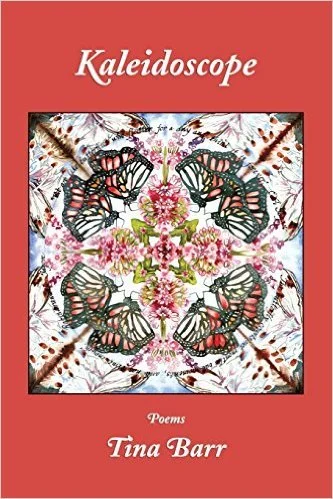
Read MoreTina Barr begins her latest collection of poems, Kaleidoscope (from Iris Press), with a perfect sonnet, “In the Kaleidoscope’s Chamber,” which ushers the reader into her colorfully patterned world. But, rather than using the kaleidoscope as a mere toy or object of whimsy, Barr’s speaker sees it as a truth device:
“The chamber fills with purple,
blue bruises, the open jaw of a dead father,
multiplies the tight eyes of liars, orange tubes
of trumpet vine, pink-tipped brushes of mimosa,
filaments sweet as what I concocted in bottles
from a perfume kit as a kid.”
Read MoreA few years ago, I was in the midst of a very uninspired period, when work and life seemed to be draining all the energy out of my writing. I decided to adopt a writing project with rigorous restraints, and to commit to writing one poem for this project every Sunday. I had already been engaging in a regular exchange of poems with a friend, which was probably the only thing keeping me writing at all at the time. But I knew that I wasn’t producing anything all that interesting, even to myself, and that I wasn’t pushing out into any new areas.
Read MoreFor a recent month I read nothing but small press, experimental poetry, and I nearly fell apart. Not that the poetry wasn’t good, but my mind wanted so badly to translate the abstract and semantically uncertain into forms I could visualize that I found my brain starving for the more transparent narrative of, say, a novel. Of course, that’s the (or a) point of poetry: to redefine language, to blur its boundaries in favor of a more beautiful thing than we might have if we stuck to literal or everyday meanings. But the mind—my mind, at least—can only take so much of this blurring before boundaries begin to seem irrelevant altogether, and I find myself harping inwardly like a grouchy critic: “Word salad!” he declares.
Read MoreSometime I’d like to teach a writing workshop about writing from your curiosities. I did once, sort of. It was a summer theater program for kids in a church rec center in Washington Park on Chicago’s South Side. We had four weeks to devise a performance from scratch. I’d decided I wanted to base it on the students’ questions—what made them curious about their community, Chicago, the world and all the people in it. I covered one wall of our room with butcher paper where they magic markered a running list of questions:
Why is it sometimes fun to be scared?
Why do people act like something is fine when it's not?
What makes a freeze pop red?
Read MoreWhile finishing my term as prose editor for Hayden’s Ferry Review, I had the chance to work on our literary darling: the “Chaos Issue.” Gathering material for this issue granted the opportunity to engage with writers exploring the far-reaches of form and content, among them Lisa Locasio. Though her contribution to the issue, “Lab,” runs fewer than two pages, it presents readers with a starkly uncomfortable, yet eerily engrossing situation, the jarring honesty of which is hard to shake. Locascio and I spoke over Skype in March.
-Allegra Hyde
Read More