Clem Marquez Interviews Cloud Delfina Cardona
Cloud Delfina Cardona is an artist, writer, and book cover designer from San Antonio, Texas. She is the author of What Remains, winner of the 2020 Host Publications Chapbook Prize, and the past is a jean jacket (Hub City Press), winner of the Naomi Shihab Nye First Book of Poetry Award. Their poetry can be found in The Offing, Prairie Schooner, The Boiler, The Los Angeles Review, and more. She is the co-founder of Infrarrealista Review, a literary nonprofit that publishes Texan voices. Cardona currently works as an associate for Letras Latinas. She moonlights as DJ Mexistentialism. She believes in a free Palestine.
From editorial assistant Clem Marquez: The past is a jean jacket is Cloud Delfina Cardona’s debut poetry collection that explores identity, sexuality, gender, and Latinx culture. With references to ‘90s bands and movies, Cardona transports us back in time through the speaker’s teenage years immersing us in their feelings of isolation, longing, and desire. In the Southern Texas landscape, Cardona’s speaker traverses their family history and past relationship.
I had the wonderful opportunity to interview Cloud Delfina Cardona. We discussed what it’s like growing up as an “out-of-place weirdo”, the expectations of Latinx culture, and the confusing nature of gender.
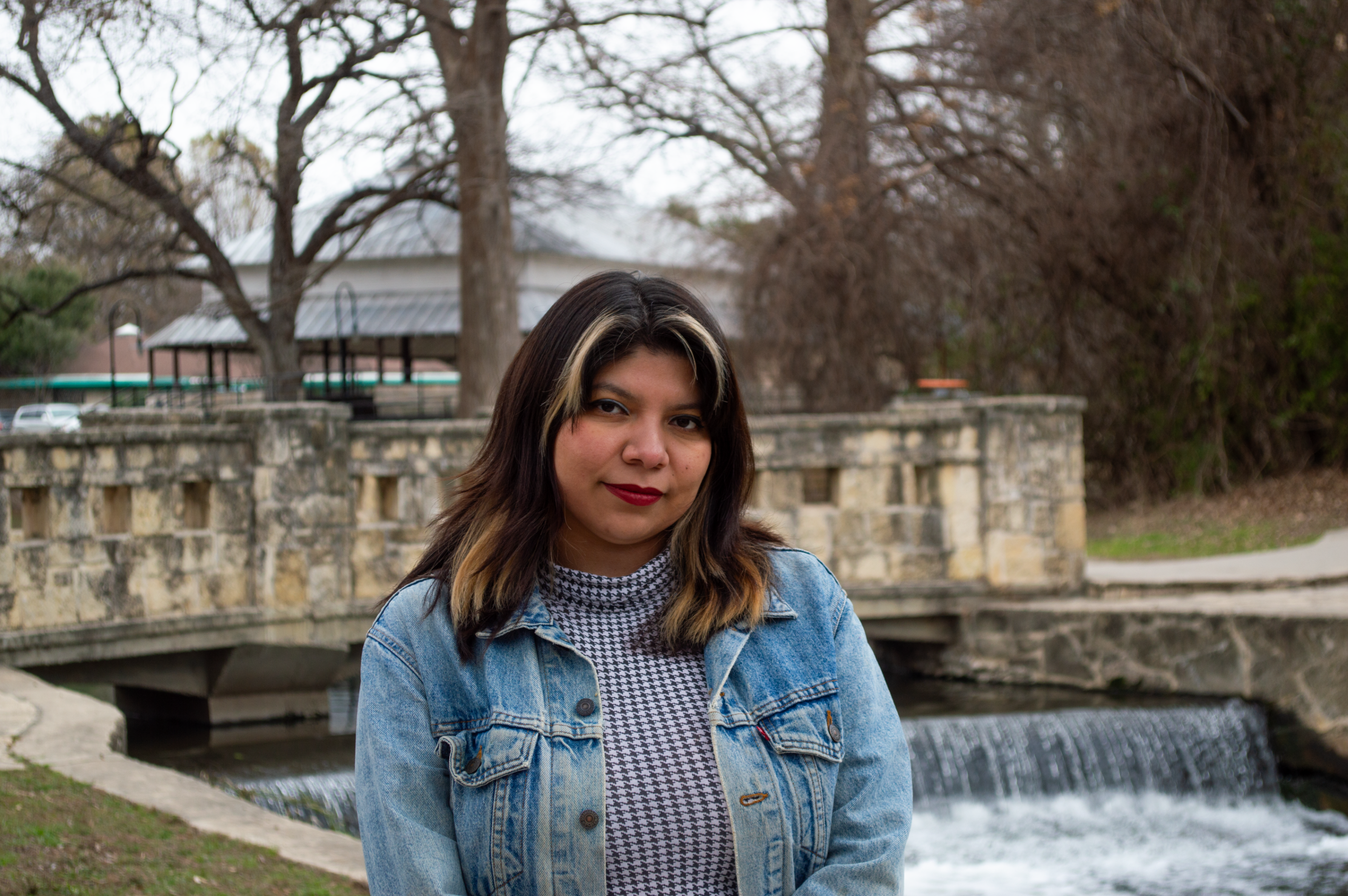
Clem Marquez: The poem “the past is a jean jacket” was originally published by the winnow in 2022. Since then, several other poems in this collection have been featured in various literary magazines and journals. What inspired you to create this collection? What was the journey of the creations of these poems?
Cloud Delfina Cardona: I wrote my chapbook, What Remains, in 2020. That was my MFA thesis work that I reworked into a chapbook. It was about my San Antonio upbringing and childhood. Some love and relationship stuff too. I knew I had to push myself a little bit further, especially in terms of writing about queer relationships and sexuality and gender. That was something I was always afraid of writing honestly. Just a lot of internalized homophobia and “what is my family going to think,” that sort of thing. I knew I wanted to come out with a collection eventually, but I didn't set out with a plan on what my book was going to be. It was literally just a poem at a time. Once I had at least 50-ish pages, I was like I guess this is a collection. I had this idea that it had to feel a certain way and be a project. I reworked it and made it a little bit chronological. I think the themes come out once you see all of your work together. In my head, it felt disjointed, but I submitted it to a contest. To be honest, Hub City was the only contest I submitted to because I didn't feel confident enough to share it elsewhere. It worked out how it was supposed to work out because they accepted it and published it. It did not feel like a book until that part. Until someone told me they wanted to publish it. And I was like, okay, yeah, I guess it's a book.
CM: The way you use pop culture references in your poems was beautiful! There is something so teen about having a constant playlist going and filling your mind with other people’s thoughts. Would you be able to describe your process with integrating pop culture into your poems? How did you become comfortable with utilizing pop culture in your poems? What draws you to reference certain media from pop culture?
CDC: I feel like there is a discussion of the poetry of the now versus the poetry of eternal time and the references versus not referencing. I listened to this podcast with Morgan Parker in grad school. She's one of my favorite poets. She very much writes into pop culture, but uses it to talk about herself, blackness, depression and mental health. She said with “The Waste Land,” there's so many references in there that you need to understand in order to fully grasp the text. And it was like, oh, so then why can't we do it? We live in an age right now where we can easily Google or search up anything. I personally love doing that. I love notes on the back of a book. I love discovering new things because of a poem or because of a book. I don't intend to alienate audiences with my references. I'm more like a texture. I want to express the full extent of my experience and that includes the bands and movies. Those were my special interests as a teenager, and it would feel wrong to remove them.
In “self-portrait as an Anna Karina GIF at 17,” so much of my isolation was remedied by watching movies and listening to music and being online. But that also contributed to the isolation, too. I was like an Anglophile. And then you're like looking in the mirror and you're like, well, why can't I look like the cool ‘90s alternative white girls? The best way I could express those emotions was by saturating the poems with these references. That feels truer to my experience. If people get it, that's like a little bonus. But if they don't, maybe they will watch something because of it or listen to a song.
CM: Kind of in the same vein, how has the internet—sites like Tumblr, Instagram, Twitter—played into how you storytell? How do they inform how you engage with media and community, and in turn, engage with the creation of your own art?
CDC: I always think about something that my best friend told me in college because she followed my Tumblr. We were hanging out, but I was also on my phone updating my blog. I was posting about what I was feeling in the moment which was juxtaposed to how I was acting that day in person. She said it's incredible to me that you're feeling all of this stuff and you're posting it online. I would have no idea because on the outside we're having fun. I've never thought of it that way, but it is a little bit of duality. I would be super vulnerable in how I felt—my depression, everything—even though it's public and anyone can go to your Tumblr, but it felt safe in high school to share that. Whereas for whatever reason, I didn't always feel safe to tell people I knew, which is probably why they were checking my Tumblr to be like what is she actually feeling? I have Pisces placements. It's been a journey to try to open up to people especially as a teenager. I think that confessional nature largely informed my poetry. It was such a large part of my teenage years. I spent so many hours trying to find out who I was and sharing on Tumblr.
CM: Music also plays a major role within your poems and within the work you do as DJ Mexistentialism. How does music influence your poetry? What genres/musicians influence your work or have affected your life in major ways? How does the way you work with music influence your poetry or vise-versa?
CDC: Yeah, I'm sitting at my DJ table right now with my turntables, actually, and I've been trying to make more time to play around with that. Music has always been so important to me. So much of the texture of my life has music in it. They say music is one thing that can really connect you to a past moment. It's like the closest thing we have to time traveling because I hear a song and I'm immediately transported to this one particular moment when I heard this song with a friend, or when we were out in the club or in the car. Having that texture in the poems—whether it's a reference to a lyric and an epigraph, or a song, or referencing the song that we're listening to on the way to Corpus Christi—feels essential to my work. When you're compiling a collection, it's like curating a playlist basically. It's like you have to think about the tempo and the rhythm and the BPM. Treating it like a playlist, treating it like a DJ set basically, is what helps me kind of piece together a project and also a poem too. With the line breaks and the cadence and the rhythm and how fast and slow it is. It's definitely been essential to my poetry since the start.
CM: Your poems involve many references to fashion. Velvet ballet flats, blue dresses, burgundy berets, oversized jean jackets. Even the cover itself being an embroidered jean jacket. With fashion being a big part of queer cultures and rock, punk, and indie subgenres, how has fashion and fashion communities influenced your art? How has your own personal style contributed to your development as an artist or to your art itself, if at all?
CDC: I have a Latina Gen X mom who always prided herself on dressing up, even if it was to go to HEB, and she ingrained that in me hardcore. I'm always aware of what I'm wearing and it just feels like it's such a big part of who I am on the day-to-day. So much of the book is during the indie 2011 time. I was thinking a lot about what I was wearing and the oversized jean jacket was like my comfort blanket. I had long hair and I would have it in the front and then with my jacket on top and then some thrifted dress that my mom probably hated because she was trying to get me to shop at Hollister. I'm a Libra rising so fashion is part of who I am. But it's also a guard. It's like drag, playing it up and playing into it. I feel like jean jackets, too, are timeless, but also evoke subcultures of all the things that basically I wasn't a part of that I wanted to be a part of. That self-expression and self-acceptance has been a really big piece of the past is a jean jacket. Like not conforming to things just because it's respectable or because that's what your parents want or because Latinas should look a certain way. I just really wanted to have that layer and that narrative kind of woven subtly in the book too.
CM: Your use of colors created beautiful imagery and really connected these poems! The final line of “like a hot tortilla on the comal, my brain bloats with longing” being “can’t you see the color of my soul?” It really stuck out to me, with how pertinent colors are in the previous poems. I wondered what associations you have to these various colors. How do you use colors to build your poems?
CDC: I love colors. My partner makes fun of me because we'll go to a museum and I'll be like, I love the colors of this one. And she's like, you always say that for every one. I feel like blues come up a lot in my work. When I'm thinking of blue light or like blue skies, it's kind of sad, but it's also calm, which I think is what I love about it. And red too. I think color is very prominent in my work throughout. As an Aries sun, I love red. It’s where I feel powerful. And it's also a Latina thing like red lipstick. It's the passion, it's the fire. Being in San Antonio, there's so much color here. In the neighborhoods, in the houses, in the parties, just in the culture. We have Mexican pink. There's so much brightness. And I'm a person who loves black and anything gothy or punky. But I do love colors, even if I don't necessarily wear them. They just speak to the experience of Mexican-American culture and a vibrancy because otherwise my poems can feel so heavy and sad. I want to at least add to the atmosphere of it. Whether that's describing the lighting or the colors of the houses on a particular street. So it's that balance.
CM: How does queer culture and Latinx/Chicanx culture intersect within your poetry? How does queer culture and Latinx/Chicanx culture intersect within your daily life, if at all?
CDC: When I feel most connected to the culture in my work is when I'm celebrating the people around me. In particular, I'm drawn to writing about women because women are amazing and that's so tied to my queerness, too. Like in “Tía-shaped,” for example. I honestly only have like two tías that I'm really close to, but I wanted to create a catalog that celebrated all the types of women that I see in San Antonio. Not just like my actual tías, but tías in spirit. Especially the women here that are working class, who knows if their stories will ever be told by their family? I think about all the women that move through life and they live, they love, they sacrifice and then they're gone. What happens to all of the work that they put into the people around them?
I struggle with writing about queerness in an explicit way because I grew up Pocha. It's an insecurity that I had for a long time when I was first writing of like, oh, my poems aren't Mexican enough or they don't feel like “gentefied.” They don't feel like I can relate to people in San Antonio. But I also need to be authentic to what I want to write. My experience is Chicana too, even if it doesn't look like other people's experiences.
I was talking to Anar from Host Publications. She's a publisher and a poet, and we’re very similar in a lot of ways. And she was like, I'm watching a Godard movie, but I'm watching it through the lens of being a Latina, so I'm going to bring something different from my perspective when I'm referencing this French movie. And I was like, that's so true. I just try to carry that with me. And having a father, too, that's a poet. He's in his 80s. He's been writing his whole life. He’s Chicano, from Alice, Texas. He literally went through segregation and taught at high schools in the ‘70s and ‘80s. His favorite writers are Zimborska and Robert Walzer and these non-Chicano poets. He also has an extensive Chicano poetry collection. We've talked about not wanting to feel boxed in by the label. If I write about flowers, does that make me less? Does that still make me a Chicano poet? Do I have to always write about my identity? And so I'm like, Okay, he's experiencing this, too, so I'm not alone in this. There's other people too that are grappling with this question and just writing what they want to write.
CM: You mentioned that your father, Jacinto Jesús Cardona, is also a poet. How does your family influence how you write poetry and what you write about?
CDC: I feel very blessed. My father's a poet. My mom's a visual artist. They both were enmeshed in the art scene here in San Antonio. They both worked at the Guadalupe Cultural Arts Center for a while. It's not like they were full-time artists. My dad has been an educator, a high school English teacher since the ’60s. My mom has had different jobs. She's worked at schools. She worked at the Guadalupe at the Centro Aslan Gallery. My mom was like don't go into the arts. There's no money there. But you get what you get from your family. I'm not good at math. I'm not good at science. I wanted to be an artist. I went to the same high school where my dad taught. People were like, you must be so good at English, or you must be a writer. So my form of rebellion was to be like, no, I'm not a poet. But of course, if you're a poet, you're a poet. It eventually came to me in college being around so many books. That's how me and my father connect. His poetry is very musical and also has an element of humor and playfulness with language. He just loves language, both Spanish and English. So a lot of his work is like in Spanglish or Galo. And he also writes a lot about similar themes in the sense of feeling like an outsider. At the nonprofit that I started, we published his book in 2021 or 2022. It was a coming-of-age story and poetry collection all about his upbringing in Alice and his parents. But also about finding solace in books and feeling like an outsider. Just a quiet, Chicano kid wanting to be like the cool vatos. I think our work is very similar in that regard. I feel like there's more of a confessional aspect to my work, whereas I think he feels a little bit, maybe, guarded. I don't know if that's the right word, but his work is all about play. It still goes into the hard stuff. There's still sadness there, but I think he approaches it differently.
CM: The poems “Filth-Shaped” and “Gender Shape” are presented as photo collages with the poems being made of cut-up pieces of sentences and words, like they were taken from something else to be made into something new. What was your process with creating these poems and these two collages? Did this format affect the topics/themes of the poems or vice-versa?
CDC: It's one of those things like as a poet, as an artist, you get inspired by different things at different points in your life and you feel called to write about certain things or create different things, do research on a particular subject. I don't know what started me on the collage moment, but I was making collages for posters and events for Infrarrealista Review. I was like, I'm going to try one. I made the collage first and then I was like, what would it be like if I layered the text over? And so I tried it and it was like, this is really cool. It made sense. “Gender Shape,” in particular, felt right. When I think of my gender or sexuality in my head, I don't know what's going on there. I just kind of embrace the mystery, but I think in images. It made sense that it would kind of come together in this way. “Filth-Shaped” was more intentional, where I made the collage first. I have all these old books that I got from McCollum High School where I taught. The library was just giving them away. I was like, these are cool. I want to use different images from here. And it was just coming together in a very dark, very hellish way. I was like, that ties into my Catholicism and feeling like a monster for my sexuality. It's all about being a teenager and looking up the most disturbing movies of all time and wanting to feel something. And wanting to feel like, okay, maybe I'm not as monstrous as I thought or finding comfort in that. That's how that one came together. I want to ideally do more of thatfor my next collection. I'm really thankful for Hub City Press. You never know what a publisher's gonna do with visual kind of works like that.
CM: Gender plays a significant role in your works, both the feeling, the experience of gender, and the perception of it. In what ways do you use gender within your poems? What emotions or themes do you invoke with it? Or, what draws you to write about gender? How do you write about the inward feeling of gender and the outward expression of it?
CDC: Yeah, it's one of those tough things like Chicanidad, like sexuality, where it's so big that you're like, how do I penetrate this topic in a poem? Where do I even start? And for me, it started with desire and relationships with men and reflecting on a lot of the past relationships I had. Now that I know what limerence is, I'm like, okay, that's what that was. But part of it, too, was that I was in love with their masculinity, but I kind of wanted it for myself. There's a Neko Case lyric where she's like, “I fuck every man that I wanted to be”. I really relate to that experience. Like I've seen that with queer women talking about other women that they desire and the border of “am I attracted to them or do I want to be them?” In a lot of movies, too, like in Persona, in Three Women. It's that obsession that a woman has with another woman. And it's platonic, but it gets to a point where it becomes a little sapphic. I feel that way towards men. I've always been interested in how they perform that masculinity and wanting to be a part of that in a way. Gender performance is where I'm most intrigued to talk about gender and to write about it in that space.
CM: A few of your poems discuss the impact of whiteness on you and your friends when you were younger. How did those experiences affect how you write about whiteness in your poems?
CDC: Where do I even begin? I think growing up in San Antonio, all of my peers were brown, but there was a lot of internalized desire for whiteness in them. In high school, the media I consumed was Brit pop, French films, Radiohead, David Lynch, Twin Peaks. That was so formative to me. In my book, it's that grappling with how I don't see myself reflected in a Wes Anderson movie. I desperately wanted to be cool like Margot Tenenbaum or like a member of the Velvet Underground. And I'm not finding that.
CM: What led to the founding of Infrarrealista Review?
CDC: When I went to grad school in San Marcos at Texas State University, I was the only person of color in my cohort on the poetry and fiction side, as far as I know. It was so strange to me because I grew up very differently from that. I met Juania my third year. She was a first year and she was a queer Chicana. She found my zine, Chifladazine. We connected and were like there's so many talented writers around us that aren't getting published. We just got really jaded at seeing presses and journals that were all white mastheads, yet wanted t POC narratives. And we're like how does this make sense? Is it because you can check off a box and be like, okay, well, we publish this many people of color, so we're good? We're just like, no, like, we're not about that. We wanted something that felt more authentic and we also wanted to pay writers. And we want to publish what we want and not care about the accolades in your bio. Like if you have them, that's great. We celebrate you. But if you don't, we're not going to disregard your work. But we just partially did it in a selfish way. We did it to push our friends to keep writing after the MFA because it's so easy for so many MFA students to just graduate and then they get jobs as whatever in whatever field and then they stop writing even though they're like incredible writers.
CM: Religion, and spirituality, also play a major role in your poems. Baptisms, sins, witches, and tarot cards. How does religion or spirituality impact your writing? What is your process in connecting it to sexuality, family, and pop culture?
CDC: I went to Catholic school through college. That was the world I knew. My parents are Catholic. They were married in the church, but we didn't go to church every Sunday. We would go on holidays when my grandma was around, but after she passed, it kind of stopped. But even if you're not practicing, it's there and it's that social contract thing of there's certain rules you’ve got to follow. I struggled with all of that internal guilt in high school. Especially being queer too. I remember growing up really feeling evil. I don't think I really questioned if I believed in it until like high school. It's still something I grapple with, but spirituality is like a big part of who I am. I take a little from astrology, take a little from tarot. Generally, I guess I'd be considered agnostic. I still feel that influence of Catholicism and I find the beauty in it now. There is something beautiful about the rituals and the more pagan aspects of the religion. All the saints and the mysteries and the imagery is really compelling to me. It feels so ingrained in Mexican culture too. It's kind of hard to separate that. And I was scared of tarot cards, honestly, until I was like maybe 23 or 24. Once I got into that, I was like this is really cool. Just something about the archetypes and the images really spoke to me and made sense to me. I guess like a literary aspect too. Just the themes and the combination of things you can get. I felt like I needed to include that. And I feel like there's a lot of different ghosts as well, maybe not explicit, through the book. Like ghosts of ex-boyfriends or people and ex-girlfriends, too, and ex-friends. I feel strongly that we have to, at least that I have to, document the past and the people, no matter how hard it is. I need to include all of that in there and evoke them. Poems to me kind of feel like spells in that way. It's an incantation and you're recalling this memory or the past. And I think that's so cool. I think that's where poetry thrives for me: in those like spells.
CM: To wrap up, what does your future look like with your poetry?
CDC: Right now I feel really called to write Texan poems. I mean, I feel like all my work is very Texan, but in particular, I'm looking at West Texan history. I'm looking at the Porvenir massacre, anti-Mexican American violence in the 1900s, and generally looking to the past to kind of have hope for the future. I find solace in just being like, oh, our ancestors have gone through some shit and, yeah, we're here and we keep on like surviving or trying to survive. I think with everything in the world right now, it's what kind of gives me—I don't know if peace is the right word—but it gives me a sense of calm.