Ashley Cameron Interviews Vincent James
Vincent James is the author of Acacia, A Book of Wonders, as well as the chapbook Rady, or Squirrelhunter. He also helped author Swerve, a collaborative novel, along with McCormick Templeman and Rowland Saifi. More of his work can be found in Juked, Hayden’s Ferry Review, Tarpaulin Sky, Heavy Feather Review, Annulet: A Journal of Poetics, Gulf Stream, Texas Review, Prick of the Spindle, Essay Daily, among other places. He is currently an Assistant Professor of Creative Writing at Viterbo University. He can be found at his website, www.fatherfever.com.
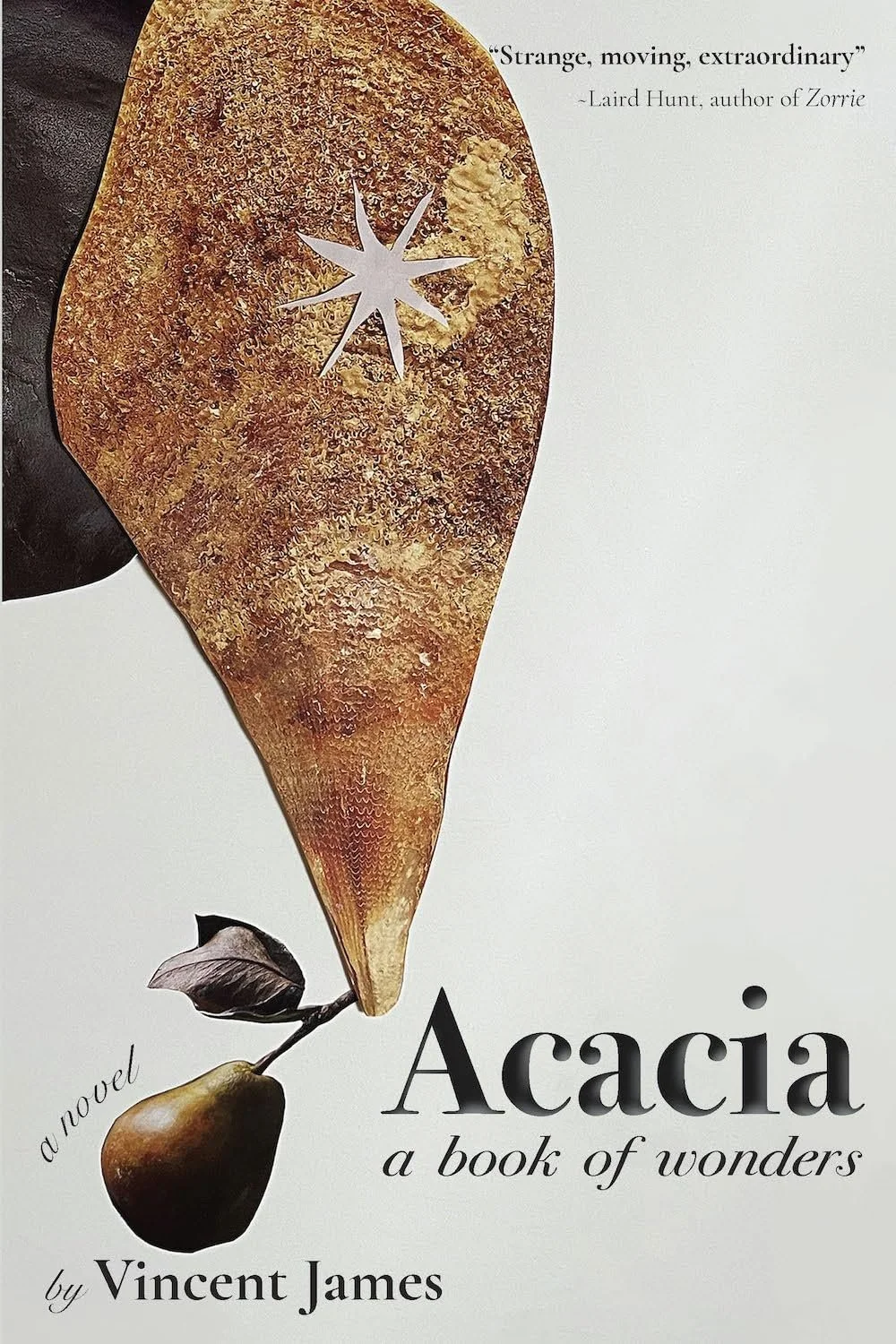
From editorial assistant Ashley Cameron: Acacia, A Book of Wonders is a captivity narrative novel set in a commune of bird-worshiping cultists in 1980s Texas. Following the eventual Matriarch of the commune, Petra Caldwell, Acacia is filled with dramatic imagery, imaginative worldbuilding, and interesting twists. You can purchase a copy of Acacia, A Book of Wonders here.
I had the pleasure of conducting the interview with Vincent James over email. There are some small edits for clarity.
Ashley Cameron: How did you get the idea for Acacia? The idea of a bird-worshipping cult drew me in immediately from the description.
Vincent James: The very first ideas for Acacia arrived in a dream. Afterwards, I spent a couple of months considering this strange image of a naked boy on a dirtbike connected to a vulture by a chain and collars. That backstory eventually merged with my interests in new religious movements, which I’ve had for most of my life—ever since I watched coverage of Waco on my grandmother’s TV.
AC: What was your writing process like? How long did it take to finish Acacia?
VJ: I am a slow writer. I don’t really draft as much as hopscotch around while working on ideas that feel charged. I take lots of notes throughout my research and look for interesting structural models. Acacia was something like a four-year book, from initial idea to publication, which also involved a good deal of work with my press.
AC: Throughout the novel, you weave in multiple different modes of writing, including poetry, playwriting, and short story. I feel that this kept me anticipating and engaged in the narrative as the experimental form had many surprises in store. How did you decide which moments required this change, and how did you pick the type that was appropriate for each scene?
VJ: I think the content of the book suggested its form. I never had a plan for what form a given section would take, or that the finished book would carry these different modes. The “little books” entries were the only consistent formal choice, which I was attracted to for their account-like reportage quality.
AC: The language of this book is beautifully lyrical. Every line could be dissected and read to an expectant English class. Yet, often the metaphors will mix together a wondrous scene or idea, even if horrible in nature, and then use some modern slang or reference that serves as a complete tone shift. You use it so consistently that it is its own art form, and a little treat for the reader. One of my favorite examples is on page 114: “The organ, pink as a piece of supermarket salmon, again exited her mouth to speak with a timbre tenuous as ash.” How did you manage to find the balance between this lyricism and the unexpected modern cultural references?
VJ: Working with these seeming anachronisms, or perhaps a better phrase might be “context collisions,” was one of my favorite parts of writing Acacia. The geographic grounds of Acacia are a kind of non-space, and in many ways this off-grid, isolationist community has completely withdrawn from the world of 1980s America. Those cultural and object references are little tendrils to the outer world that give materiality to the context of Acacia’s belief and life.
AC: As the protagonist can be violent, self-centered, and hypocritical, did you ever worry that Petra would be too unlikable? What was your thought process in designing her character?
VJ: One of the most interesting questions for me about new religious movement leaders is the degree to which they believe their own messaging. What motivates their choices? Is it always about sex, or power, or both, or is there a mix of authentic belief within their dogma? One of the unique features of Acacia is the book is told from Petra’s perspective, in first person, and her reportage of Acacia includes wrestling with revelation and Divine mandates, actions undertaken while in prophetic states, and also her own admitted personal failings. Petra does many bad things in Acacia, some of which she is willing to acknowledge, and others which she attributes to Divine will. The reader’s relationship to Petra may in some important ways be informed by how they interpret Petra’s relationship to her own past, her truthfulness in composing the account, and whether she believes, or is acting, in accordance with Heaven’s direction.
AC: This book is a clear satire of religion and how easily people can be subjugated (or corrupted by power) through belief. Did you take any inspiration from any other satires in structuring your own?
VJ: I didn’t approach Acacia specifically as satire, though I was certainly interested in some of the dynamics you identified, such as power, outright abuses of power, manipulation, and leader worship. But no, I didn’t have any particular satirical models, though satire’s comedic aspects are also attractive to me as a writer. And I do think, at least for me, that Acacia is often very funny. More broadly in my work, I am interested in how humor and levity work in grim contexts.
AC: The world building of Acacia is really interesting. I especially liked the funeral rites that interweaved human mourning and the returning to the vultures/heaven in death. Did you struggle to find ways to integrate vultures, whether physical or iconographic, into the culture of Acacia?
VJ: No, not particularly. Vultures are such fascinating creatures, and they provided many narrative resonances within this religious movement. As I wrote and researched in-tandem, ideas about vulture behavior and their historical symbolism inspired events within the book.
AC: What was your decision to inform the reader in the book's description that Petra becomes the matriarch of Acacia when it is not revealed in-world until after the halfway point? Was there a purpose to making it clear in the synopsis?
VJ: Petra’s in-text revelation about assuming power over Acacia happens midway through the book, but the opening letter she offers the reader as a frame for her account also establishes her position as the matriarch. The book, her book as a statement of her captivity, captures the arc of that journey, and I hope that readers are able to occupy those various positions she holds—as the matriarch, but also the little girl, the outcast, the captive.
AC: I loved the ending of the book; the idea that Acacia’s greatest fear never came and that their leader was brought down by her own actions really drove home the satirical nature of the story. Did you have this ending—this idea of fate, retribution, cyclicality—in mind from the beginning or did it arise as you wrote?
VJ: Acacia began with a significantly different trajectory. Petra’s experience was an unfolding process to me as much as her. I really have never been able to architect large scale projects; those results always end up feeling stilted. The process of discovery is more pleasurable, and also seems to allow for a greater sense of emergence and summative consequence. That all being said, I did have a few governing ideas that I think helped guide the story. For example, I knew I wanted to work with ideas behind and about the rapture, and I think those made it into the book in their own ways.
Ashley Cameron is a writer from Gilbert, Arizona. She is currently finishing her Bachelor’s degree in English at Arizona State University, where she is working as an editorial assistant for Hayden’s Ferry Review.