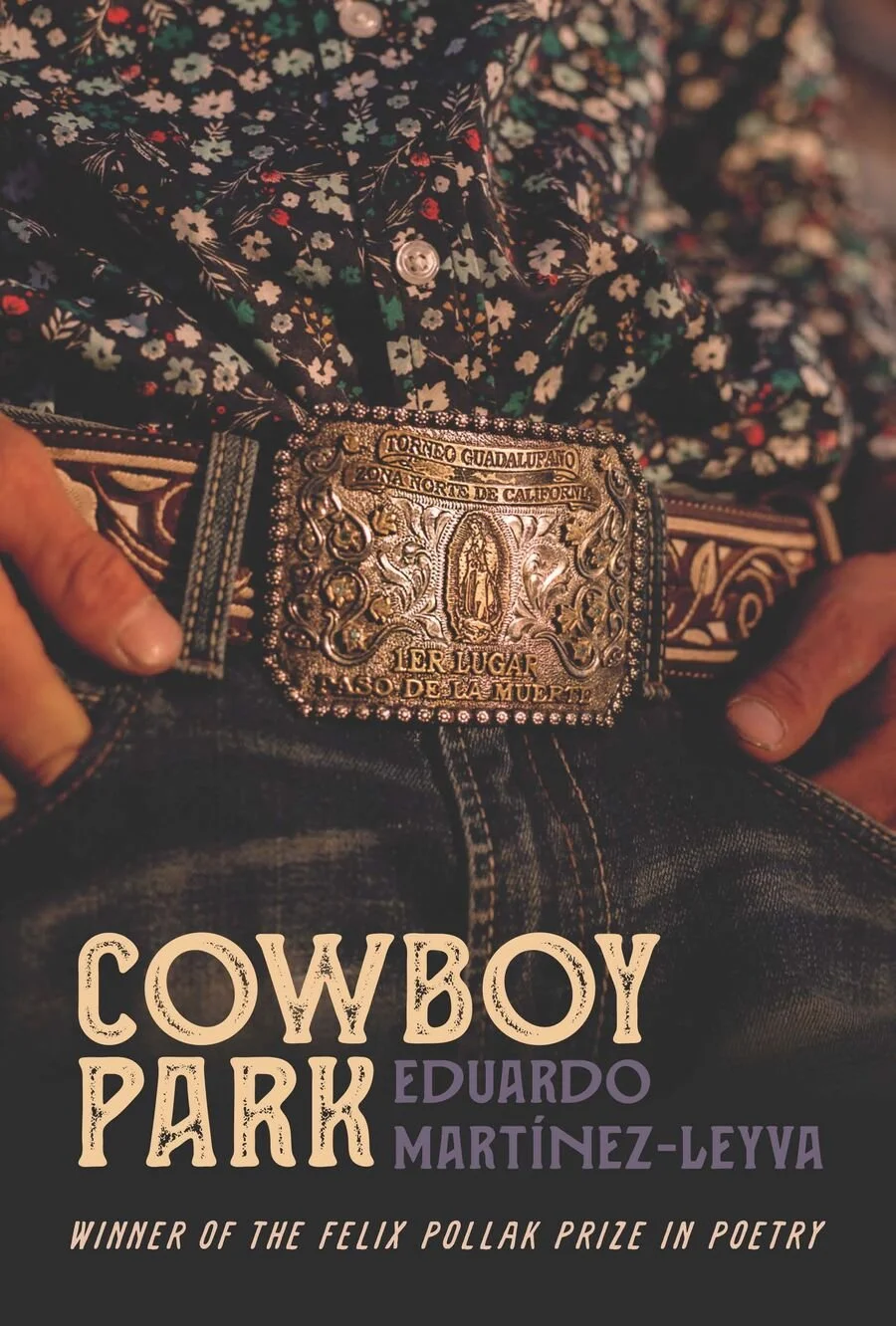
Review of Eduardo Martinez-Leyva’s Cowboy Park
by Poetry Editor, Siobhan Jean-Charles
Mothers are swarmed by ICE agents while awaiting immigration hearings. Nurul Amin Shah Alam, a 56-year-old blind Rohingya refugee, was murdered by ICE, abandoned miles from his home and left to die of hypothermia. No arrests have been made in the killing of Keith Porter, Alex Pretti, or Renée Good. The chaos and violent mass deportations that President Trump promised during his campaign have been terrorizing communities from Minneapolis to Phoenix. Turning to poetry in times of distress can seem futile, but generations of writers have written through enormous grief, fear, and loss. Eduardo Martínez-Leyva’s debut poetry collection Cowboy Park winner of the 2025 Lammy Award for LGBTQ+ poetry, is necessary, intimate, and precise.
Before I knew poetry, religion introduced me to beauty. Growing up in an insular homeschool community, Catholicism was the center of my life. At Sunday Mass, I was enchanted by the scent of myrrh, the dove-white lilies, and steeples reaching sky-ward. Because women are not allowed to become priests, the women presented to me as role models were the Virgin Mary and the pantheon of women ordained as saints—people who lived so virtuously that they are believed to be in heaven after death. My youth group learned about St. Gianna, who refused an abortion and died a week after her fourth child’s birth. St. Catherine of Sienna cut her waterfall of hair to evade a suitor. Womanhood, I thought, was earned through sacrifice and suffering. To be a good woman, you had to accept that your body was not your own.
I wanted to be as beautiful as the saints, crowned in convent gardens with wild roses. I longed to be feminine, but my expressions of femininity were mostly understated. My mother, painting my nails, forbade me from wearing hellfire red nail polish.
In “Colorette,” Martínez-Leyva writes:
“For your seventh birthday, you asked for a shade
of lipstick so dangerous your mother blessed herself.”
Cowboy Park is a collection that wrestles with language learning, uncertainty, pleasure, and depictions of masculinity, fueled by a Catholic upbringing. The power of cosmetics, wigs, and clothing to transform the wearer is constant throughout the collection. Martínez-Leyva is a poet of embodiment, grief, intimacy, and place. He deftly leads the reader through the trailer parks and dimly-lit dive bars of Central Texas and Massachusetts, rendering an intimate portrait of the South and its legacies. The poems embody the grit of late-night hookups with striking lines pulsing with salt, truck stop gloryholes, leather harnesses, and the unpredictable violence of strangers’ hands. The poetry often straddles the line between desire and disgust, reflecting its exploration of power dynamics. Martínez-Leyva reckons with the dichotomy of good versus bad, a product of the speaker’s religious childhood.
The first poem of Cowboy Park is titled “Learning the Language.” Martínez-Leyva writes:
“To translate confection, my boytongue
nicked the hive’s bloated colony.
No script or art to believe in, just sugar
paining the pink of me. I welcomed
polygamy, the plural of sting. I arrived
by way of thirst. The strongest hurt
came from the queen. Her species
(awe and expert) were a light I asked
to swig. I was convinced she could
give me what I always wanted from a man.”
Martínez-Leyva compares learning English to licking a swarming beehive, lured by the honeyed promise of mastery. The speaker uses the simile to suggest that the more expertise the speaker gains in English, the more pain they experience, and later we see that the pain stems from confronting the ways English is used to dehumanize immigrants. “Learning the Language” is an ars poetica which grapples with the possibility of gaining fluency in a language that is often shaped into a weapon. Learning English itself isn’t enough to help the speaker survive the dangers of living in the Southwest. In “ESL Lesson,” he writes:
“Before there is language,
we make sound, spell things inside our mouths,
expecting those objects to tumble out of us:
Paper clip. Pomegranate. Company.”
The poem ends:
“We learn synonyms and antonyms; the definition for us:
Low-income. Brown. Faggots. From the other side of the tracks.
We learn fast. We learn how to run fast. We learn
how to outrun those things that will slaughter us.”
For the speaker learning English as a second language, English is a tool of survival to recognize danger and continue survival. The slurs and degrading language hurled at the speaker are described as “synonyms” and “antonyms,” but the speaker does not clarify which is which. Alongside its exploration of bilingualism, the collection reckons with a mother’s survival after a hate-crime shooting, and a brother’s deportation. The ugliness of English and its epithets is juxtaposed alongside imagery of hissing diamondbacks, lipstick smudges, and violet knuckles. Spanish is woven throughout the collection, giving the speaker access to a well of language, and more ways to articulate their experiences. Cowboy Park writes into the confusion, pain, and grief to create a subversive and reimagined archetype of the American cowboy. Martínez-Leyva crowns beloveds and family members, honoring their memories and sacrifices, giving the exiled a new home on the page.
Siobhan Jean-Charles graduated with her Bachelor's from Salisbury University in Maryland, and is a MFA candidate in Poetry at Arizona State University. She is the blog editor for The Shore Poetry and was a finalist for the Subnivean Award, judged by Major Jackson. Her work has been nominated for a Pushcart prize and received support from the Virginia G. Piper Center for Creative Writing. Siobhan's poetry is published or forthcoming in Passages North, Cider Press Review, Tinderbox Poetry Journal, and elsewhere.