Review of Anne Waldman's Mesopotopia
by Associate Editor, Hannah Palmisano
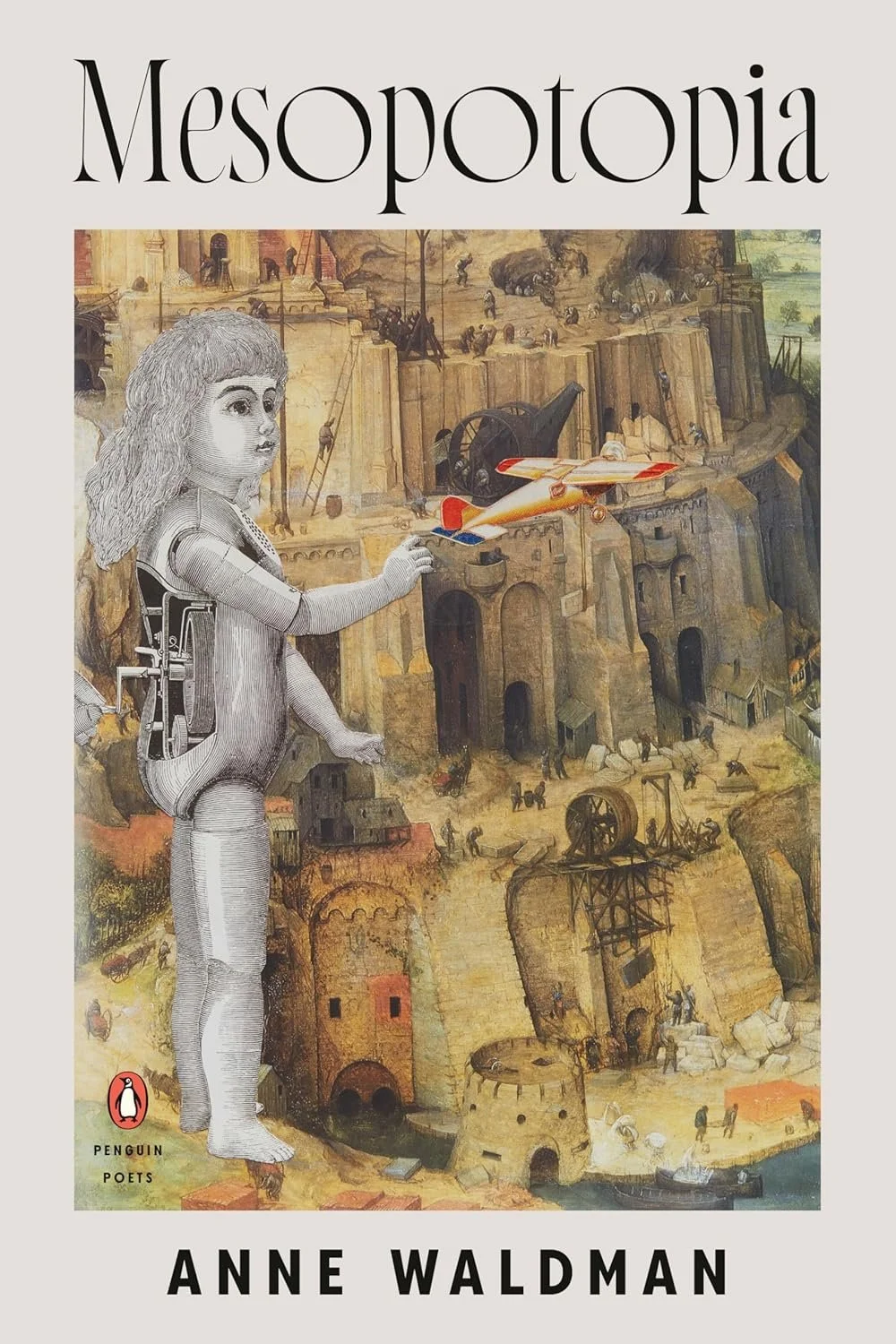
Anne Waldman’s Mesopotopia explores a vast range of historical moments, personal experiences, and imaginative landscapes, drawing cross-cultural connections through time. The collection is structured as seven staves, with naturalistic illustrations and photographs accompanying poems that use associative leaps and deliberate pauses to invite the reader to reflect on both the text and their own response to it. From the opening lines, Waldman’s poetry is best read aloud, and felt to me like a torrent, rushing forward with a sharp, driving rhythm that comes alive even more so when spoken. She pulls the reader into a rhythmic and immersive experience that emphasizes the musicality of language as much as its meaning.
Waldman masterfully shifts from concrete images to more abstract and surreal moments. When the poems move associatively, she transitions fluidly from real-life experiences to historical references and sometimes whimsical imagery, creating a dynamic, multi-layered reading experience. This rapid movement between ideas to images encourages the reader to pay attention to the unexpected juxtapositions and shifts in time that unfold line by line. This technique is exemplified in the lines “Zeus survived because of Serapis / the cross, the fish, the anchor, the leering / Jonah under the gourd a sleeping Endymion / lamb carrier, our land as / hieratic—the apse. / Christians started burying their dead in sarcophagi” from the Confessions section (147). Waldman layers mythological and Christian imagery in a way that resists a single, stable timeline. The effect is both disorienting and compelling, requiring the reader to actively navigate the connections between images rather than passively receive them.
One striking feature of Mesopotopia is the way in which Waldman occasionally shifts focus to highlight and elaborate on personal and historical moments within her poems in a fourth-wall break that still manages to remain lyrical. Sometimes she pauses to position herself in these histories; in these moments, her personal experiences—ranging from her travels to Italy, a residency in Umbria, and a poetry festival in Berlin—intersect with literary and historical references, including the 2006 murder of activist Brad Will, prehistoric artifacts from Blombos Cave, and early human origins in the Aurignacian period, revealing her thought process in the creation of her poems. For example, in a poem that moves between artistic reflection and imagined history, she writes, “Shifting, with slippery sand, a mercurial return, ‘sublimely unempathetic’ as Agnes Martin might say. And this is the part of the dream of a battle scene: Persepolis heaving. I am called to this, called to precarity” (95-96). Even when references are made that are unfamiliar to the reader, these moments serve to situate the poems in a broader web of reflection and imagination, revealing how Waldman intertwines personal, literary, and historical threads to great effect.
The collection also includes lines that exemplify its imaginative range, such as “agaric mushrooms / growing / on the moon… / where a hero & / heron ride by / on a cerebrum” (71). Moments like this emphasize the collection’s commitment to imaginative freedom, allowing images to resonate through association rather than direct explanation. Placed adjacent to a longer poem, this shorter, more surreal passage provides a moment of surprise. Its fantastical imagery contrasts with the more grounded, earthbound lines that appear alongside it. These lines are a strong example of how Waldman often combines natural, celestial, and mythic elements in a unique and refreshing way. Sections like this underscore Waldman’s skill in crafting moments that are both playful and thought-provoking, contributing to the overall fluidity and energy of the collection.
In Mesopotopia, Waldman balances moments of intensity with contemplative spaces. Her associative leaps, combined with periods of reflection or explanation in the staves, create a rhythm that allows readers to navigate the collection in a way that is experimental rather than strictly interpretive. The poems explore complex ideas and histories, but the emphasis on line-by-line rhythm, imagery, and structural variation ensures that the reading experience is rich and layered, even when the meaning is not immediately clear. The poem “Avicennan Medicine,” for instance, is a strong example of Waldman’s exploration in form as she uses epigraphs, italics, images, lines staggered on the page, crossing from one side to the next, and font size—shrinking then growing then shrinking again—to weave a reflection on memory that is both clinical and playful (104).
Mesopotopia challenges conventional narrative structures while rewarding readers who approach the poems with openness to associative thinking, striking imagery, and the musical qualities of language. By juxtaposing historical and personal moments, concrete images with abstract or surreal elements, Waldman invites readers to engage with her poetry as a dynamic, evolving experience. Her work is energetic and thought-provoking, offering a reading journey that relies on perception, imagination, and reflection as much as literal interpretation. This approach ultimately reinforces the collection’s resistance to fixed meaning, encouraging readers to revisit and reinterpret its shifting images over time.
Hannah Palmisano is a second-year MFA student studying fiction at Arizona State University. Her work has been supported by the Maya Smith Creative Writing Endowment Fund and the Aurelie Sheehan Memorial Scholarship. She also dabbles in poetry, and is one of the winners of the UA Poetry Center’s 4th annual Haiku Hike.