A Softer Place to Land: Briana Martin Interviews Fatima Hirsi
Fatima-Ayan Malika Hirsi is the author of the chapbooks MOON WOMAN and EVERYTHING GOOD IS DYING. Her debut full-length collection, Dreams for Earth, was published in September 2025 by Deep Vellum. As a daughter and a mother, her experiences have shaped her writing. Hirsi’s work has been featured in MAYDAY and has received praise from writers including Ashia Ajani, shō yamagushiku, Sasha Banks, and Rita Wong.
DREAMS FOR EARTH is available now from Deep Vellum here
From Editorial Intern Briana Martin: Dreams for Earth is a deeply moving collection that threads together motherhood, ancestry, environmental grief, and collective care. Fatima’s poems shift fluidly between family memory and urgent global realities, creating a collection that feels both personal and deeply rooted in community. Fatima’s writing lingers in a way that allows the reader to contemplate questions about justice, connection, and the future long after the final page.
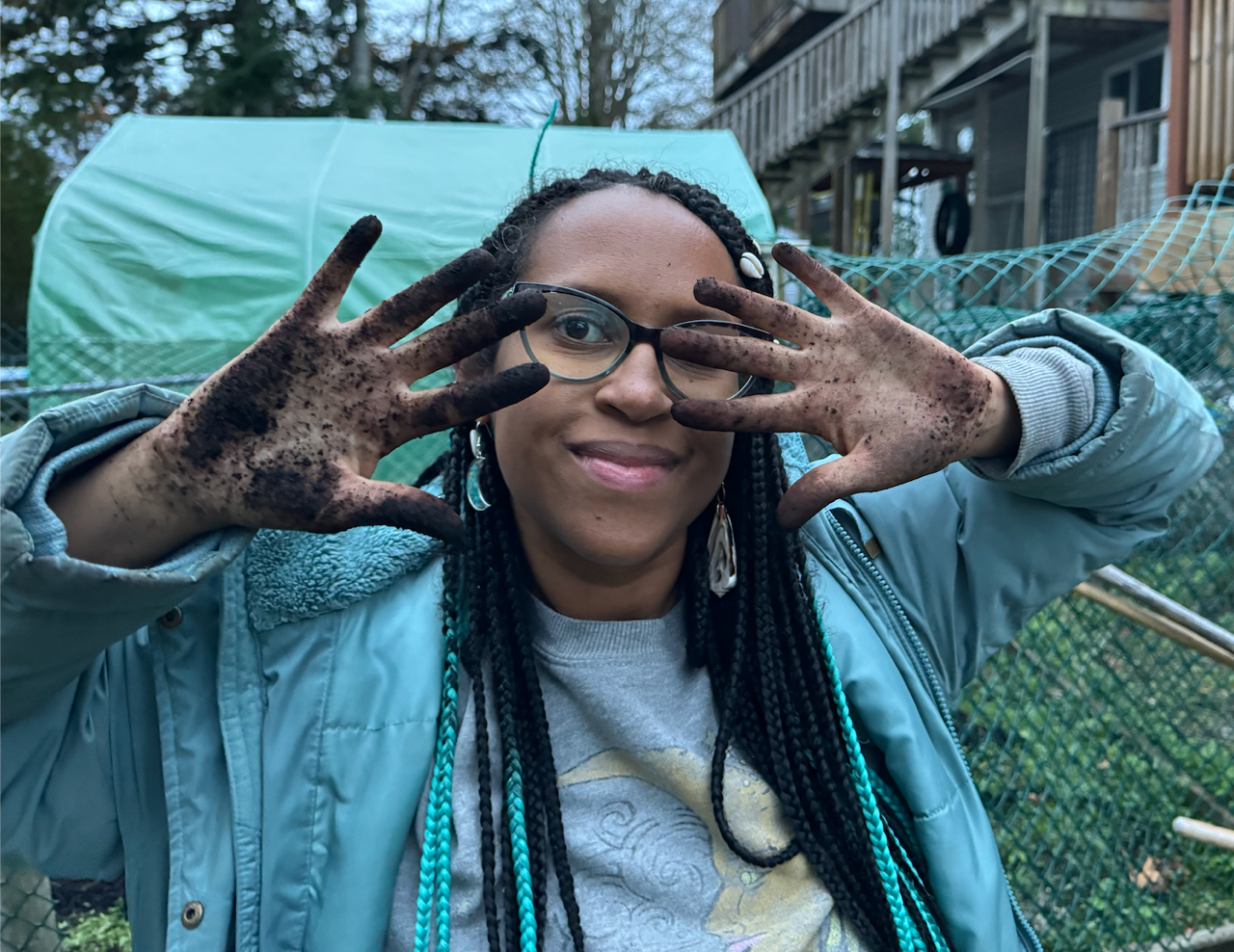
Briana Martin: You've dedicated your work to your mother and children, which creates a generational connection. How did those relationships shape the emotional and imaginative components for DREAMS FOR EARTH?
Fatima Hirsi: My identities as a daughter of Malika and as a mother to two daughters shapes everything swirling around me. My mother was and is still my best friend, and I hope to have a similar relationship with my daughters. That means accepting that their fates are tied up in everyone’s fates and we are all tangled up in each other—and isn’t that a nice way to be? Being so tangled up in others it helped me consider collective kinship throughout the book—what if we were all invested in each other’s well-being beyond the confines of blood or borders?
BM: I loved how DREAMS FOR EARTH moves between personal memory, motherhood, and global crises. Was there a particular moment or experience that first sparked the writing of this collection?
FH: Not a moment, but an ache—I wanted children for many years before my children arrived. Two of the poems in the book are from that time, over twelve years ago. Those poems spoke to someone who didn’t exist: I want to give you a world. The world I wanted for my future children back then is the same world I want for us all today—a world where everyone has what they need, where people aren’t kidnapped off the street, and where families aren’t bombed while they sleep. That original ache of wanting to give helped me write about the world we deserve.
BM: The collection uses a variety of poetic forms, including ghazals, abecedarians, and duplex poems. How do you decide which form a poem should take, and what role does structure play in shaping meaning for you?
FH: Poems like to play dress-up. They put on clothes then look in the mirror only to frown and bite their lip, shake their head. Sometimes repetition asks for a container to hold it, or a certain line might have five meanings if what’s around it shifts—those are some times I find myself exploring form. Form is like a container that helps the poem tell its story. I experience the abecedarian as a journey with a lot of research—it’s driven more by what I don’t know, something is interesting and I want to look at it from a thousand different angles. Then there’s a duplex, which I experience as a big emotion, a haunting, and I want you to be haunted with me. Sestinas feel like puzzles where the border pieces have a certain vibe but the interior is a total mystery—like you have the accessories to your outfit but you need to fill in the core. The book has a form called the orb that came to me because I share my porch with orb weaver spiders. The first word of each stanza becomes the last line of the next stanza. The final tercet has all seven repeated words in backwards order. I wanted certain words to reverberate in different ways, like the web vibrating both where a bug gets caught and where the spider feels it, and across all the space between. The last word of all middle lines rhyme, and the last word is the first word in the poem—I think circles have a lot of magick.
BM: When writing these poems, were you thinking about them as part of a larger collection, or did the connections between them emerge later as the manuscript came together?
FH: The poems arrived as individuals without me having a solid idea of how they’d live in a larger ecosystem. I found myself in a process of threading them together, and by grouping them into subjects I found myself telling a chronological story, starting with my parents and ending as a parent. These subjects are illustrated by two artists who happen to also be two close friends. I’m so grateful to Ángel Faz and Jack Anna Jackson for giving new life to the connective tissue between the poems.
BM: Several of your poems reflect on pregnancy, motherhood, and raising children in a world facing environmental and social uncertainty. How has motherhood influenced the way you approach writing about the future?
FH: Parenthood makes me always consider the future, even though the horrors of the day make it hard to imagine a personal future. Motherhood makes me want to protect others in such a way that I never thought to care for myself. To me, protection means awareness—so to write about the future we need to be able to process our current reality with open eyes. Motherhood and writing about the future both ask us what we’re willing to do today to make tomorrow a softer place to land. Living in a world where it seems cruelty is the point means a lot of what I’m writing are pleas for us to give grief and rage the action they deserve. We can’t write about the future in our poems without giving it our attention in daily practice off the page.
BM: Environmental concerns run throughout the collection, but they are often intertwined with questions of justice, history, and community. What role do you see poetry playing in conversations about climate and environmental responsibility?
FH: We could be talking about the climate or about ICE or about genocides or about what the billionaire class likes to do with their time on an island—the role of poetry is the same across so many conversations. The answer is that the bulk of the work of a poem is not what it does on the page. It’s not about the craft, it’s about what is conjured. It’s about what the poem plants inside a person, what lingers after reading, what will come of all those words? I hope the poems help us to see ways we can be part of changing systems that harm us all. Poetry asks us always to get to the heart of things, the root of the matter—so if I’m writing about environmental responsibility I’m not preaching to people about lowering their energy consumption or recycling, I’m begging for us to protect one another from those who poison the Earth for generations so they can make a few dollars today. Maybe a poem might have some facts about a particular topic, and learning XYZ might haunt you—you’ll think about it while washing dishes and while driving to the dentist, or you’ll feel the story/energy of the poem with you louder than words of your co-worker—what do you do with that? Something! You do something.
BM: Many poems in the collection return to natural imagery such as water, birds, seeds, and soil. Do these images arise organically as you write, or do you find yourself returning to certain symbols intentionally?
FH: I often hear this idea referenced that we are the sum of the five or seven people we spend the most time with. It’s natural for our relationships and what/who we love to show up in our writing and for me the living beings around me are ever-present. I don’t have to go looking, but I often do end up looking closer: Alright, hi _____, you’re here! But what are you doing here, why are you here?
BM: Your poems move between intimate family moments and global political realities. How do you navigate writing about deeply personal experiences while also addressing broader social and political issues?
FH: My brain doesn’t know how to separate my individual experience from our collective realities. It’s jarring and surreal. If we have a birthday party for our children, we invite people to donate to XYZ in lieu of buying toys we don’t need. The personal is political. I rarely experience intense joy and gratitude without an internal conversation between myself and God where I ask why everyone can’t have whatever wonder is before me. We need to collectively be asking this question—on a cosmic level we don’t know the answer, but on a material level we do. A lot of my writing is trying to understand the cosmic level of things I can’t explain—and in this I am not unique. I talk about this with friends and they uplift the work our ancestors did so we can have these blessings—but I don’t believe my ancestors love me anymore than Hind Rajab’s or the children killed while at school in Minab with my tax dollars. I believe poetry and art more broadly can be us receiving something from the divine—but I also think the poems can also be us asking the divine WTF? Sometimes that WTF is concerning awe—how is this thing so glorious?! Sometimes it’s the opposite. Often, those two things live beside each other.
BM: What does your writing process typically look like? Do poems tend to arrive quickly, or do they evolve over time through revision?
FH: Both! The seed of a poem comes easily—the feelings paired with images and memories and metaphor. But revision is where a poem blossoms. It’s where questions arrive and where I learn what I’m really trying to say or ask. It makes me explain myself to myself, and feels like I’m staring into a mirror and being present with a new detail on my face. I love revision so much because getting to know the poem more feels like falling in love with a person, when every phone call is better than the last, and every time they speak you observe something new that had been there all along.
BM: What do you hope readers carry with them after spending time with DREAMS FOR EARTH?
FH: I’m thinking about a line from the 1959 film Black Orpheus where, while carrying the body of his beloved Eurydice up a mountain to his home, Orpheus says, “It’s you who is carrying me.” I want us to remember that we carry each other. I hope to see more distance from the idea that what happens to you might come for me—and instead be guided by compassion rather than self-interest. I want us to collectively move toward a solidarity that disrupts.