Audrey Treon Interviews Temperance Aghamohammadi
Temperance Aghamohammadi is an Acolyte of the Exquisite. A trans Iranian-American poet, medium, and critic, she is the author of BATTALION SHAPED GIRL (DISCOUNT GUILLOTINE, 2025) and Behnt (New Delta Review, 2026), selected by Dorothea Lasky as the winner of The New Delta Review Chapbook Prize. Her work appears in The Kenyon Review, The Yale Review, New England Review, Fairy Tale Review, Poetry Daily, and elsewhere. She is an associate editor at RHINO Poetry. Hailing from the Northeast, she currently haunts the Midwest.
Her debut collection, BATTALION SHAPED GIRL, was released in September 2025. You can purchase it here
From Editorial Assistant Audrey Treon: BATTALION SHAPED GIRL is a collection of poetry that holds no reins. Mystical explorations of selfhood juxtaposed with poignant understandings of reality cultivate poems that are unlike any other. Aghamohammadi writes with a ferocious vulnerability that comes alive with each word.
This interview was conducted over Zoom in March 2026 and has been edited for length and clarity.
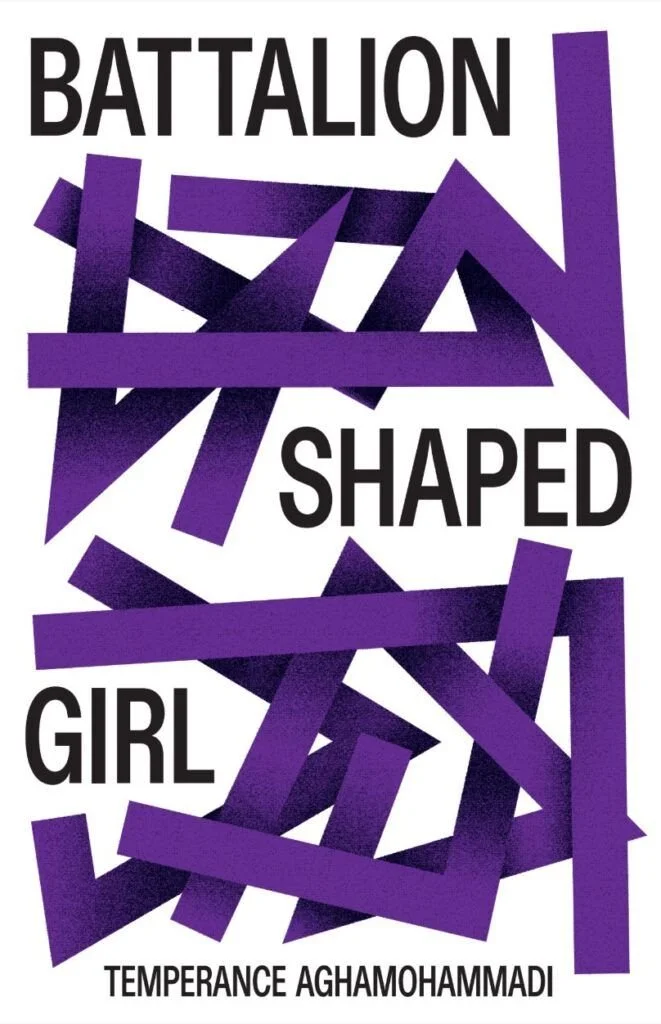
Audrey Treon: I found the title to be so unique and immediately captivating—to take two words, “battalion” and “girl,” that oppose one another in cultural vernacular. For me, it created an immediate tension of sorts, a push and pull. What was your titling process like?
Temperance Aghamohammadi: The title of the book has always been BATTALION SHAPED GIRL The phrase arrived when I was writing the title poem, which was originally an ekphrastic poem of a Franz Klein painting called Bethlehem.. As I was writing that poem, I was thinking about the ways that language mutates and how, within that mutation, there can be both tension and facilitation and collaboration. unlikely words and unlikely image pairs or sounds can create this productive tension where, within that singular atomic moment of tension, new meaning arises.
Thinking more broadly about, “Battalion Shaped Girl,” I suppose it came out of a frustration with the current cultural milieu we’re in. Despite our best efforts, there's still a lot of imposed and violent fixity about who someone can or should be. And within this current political state and global state in which atrocity and violence are being brought upon the most vulnerable here in the United States and in Iran, even more now, to me the title speaks to a necessity of being a plurality, as well as for plurality to be a singularity—one operative instrument that works together and also operates within the individual. If you're a plurality, your multiple selves will not always align. They are all ligamented by the fact that they are you, but all these different selves can possibly be moving in different directions. How do you reckon with that? I see a lot of tension and violence in everyday life, from stepping onto the street, the dance floor, doing something as simple as going to the shops, or talking to a friend, there is always something underneath the surface where the grammar of your life is both always emerging and always potentially being suppressed.
AT: Speaking of language, you have a very specific grasp on diction in this collection. I found you often opted for enchanting synonyms for commonplace words to beautify the language. In “Fetish I” you write “Holt in my crepuscular hour. As a / rusted locket. Rictused fingernail prodding. The clasp. Revolting / against fissure,” and in “Don't Let me be misunderstood,” you include a Farsi phrase, “گل بی گلدون” that translates to “flower without a pot.” As you were writing, were you consciously trying to create this unique and ornate signature rather than being more minimalist?
TA: I don't think I was intentionally trying to be either ornate or minimalist or anything in between. What's important to me in crafting a poem or art piece is that we have all of this language available for use, and while synonyms produce parallel meanings, they're not exactly the same. It's the differential in definition, the sonic registers, how the word itself feels in the mouth, the textures of the word, and how those textures interact to create a quilted linguistic textile that matters to me. By defamiliarizing ourselves with language, we become more conscious of the ways it governs our lives. I mean, I do love a moment of ornateness, but not simply for the sake of being ornate. g the spectacular image or the image of spectacle creates a reckoning. Does that moment of tension mean? Where something doesn't explicitly make sense to you quite yet, but it is speaking to you? Something happens there. I’m interested in that moment. In general, I reject ideas of legibility and illegibility altogether, as sometimes those words are used as synonyms for palatable.
For me, it is a concern about where the poem's essence lies. What language does that essence require? You mention the phrase in Farsi, گل بی گلدون, which comes from a song by Googoosh, a very famous Iranian singer, and that song is quite popular—it has romantic and revolutionary registers. I'm interested in how something on the surface can look like a love song, but it could be a revolutionary song, or a revolutionary song could actually be about love, or both. Using a different language, or language not of everyday speech, unlocks some new registers more easily. A word like “holt” has less sociocultural history than “den.” While they mean different things, there is less temporal baggage—those words don’t make the same truth claim.
AT: Are there any others you take linguistic or poetic inspiration from? I saw you quoted Iranian poet Forugh Farrokhzad’s Another Birth a few times in the epigraphs. Does Farrokhzad in specific hold a weight in your writing ethos?
TA: Oh, absolutely. Farrokhzad is sort of my North Star in many regards. I came across her poetry when I was quite young, and she did inaugurate me into the linguistic, emotional, and affectual patterns that I’m a practitioner of now. Her work is singular, passionate, and vivid. She is my muse
AT: I read a bit about Farrakhzad and learned she was a multidisciplinary artist, she touched many mediums. Are there any other art forms that you like to dabble in for fun, professionally, or in any capacity?
TA: Farrokhzad was a polymath. She was a director,a filmmaker, and a poet.I am so intrinsically drawn to artists like her, who do multiple mediums . Right now, my mediums are poetry, and I’m also working on some fiction. I’m a performance artist, as well, using my readings as an opportunity for performance pieces:— that are movement, dance, and endurance-based. Those are the artforms speak to me now. I’m very interested in films. I’m not a filmmaker, but I am very invested in film, filmic language and imagery, and the temporality of its operation. More than anything, I find myself being influenced by many different art forms, beyond just poetry. Most of my inspiration comes elsewhere, from artistic investments other than poetry.
AT: Battalion Shaped Girl was published very recently in the fall of 2025. How have the past few years been regarding the violent attacks on transgender rights and livelihoods, and the bombing campaign in Iran. Do you have any daily practices or rituals that keep you grounded and able to move through the world?
TA: Everything has affected me immensely and totally; how could it not? It’s strange because, in some ways, some of what I’ve written about in the book has become even more prescient, which is personally devastating. I wish these things weren't happening and that the entire life and rights of people weren't being stripped away both domestically and abroad. I think it's important to live radically in the moment, in a state of unsettlement, and to reckon with it. I believe that can be a catalyst to do more work on the ground—to live in that potential energy of unsettlement and convert it into the kinetics of action. The past few years, and this cannot be understated, have been horrific. I don't think we should live get accustomed or used to this. As soon as someone gets used to it, then something has been taken from our soul.
AT: Diana Khoi Nguyen, author of Root Fracture, described this collection as “Part anthem, part Victorian rock ballad…” I couldn’t agree more. Your poems truly blended those two distinct sensibilities into one. If you as the author were to describe this collection with two words or phrases, what would they be?
TA: I’d say it’s part liturgy and part grimoire.
AT: What is next on the agenda for you as a writer? Are there any themes you’re gravitating towards at this point in your life and career? And how do you see the creation and publishing of Battalion Shaped Girl fitting into your future prospects?
TA: Battalion Shaped Girl is the book that always needed to be my first book: its eccentricities, its wildness, its untamability. The next project I have is called Behnt, a chapbook that’s coming out in early July with New Delta Review, having won their 2025 Chapbook prize judged by Dorothea Lasky. It's a text about the death of my mother in 2023, and how that completely sundered me. It rails against the traditional elegy and the typical idea of control. What I felt, and still do feel, in the wake of her death was a complete annihilation. It feels like glass breaking over and over again. So, I had no interest in writing poems of grief that felt controlled, too at a remove, or poems of grief that felt too refined in a sort of minimalist way. These are maximalist, decadent, rococo expressions of grief set in speculative realms. They take place across history, in the past and future, as well as across myth, magic, and the spirit, tracking the ways in which the death of someone important to you collapses time. Perhaps in that collapse, your grief, your sorrow, can be felt in this moment, the moment before, and the moment that follows. I'm moving very, very slowly towards my second full-length. I don’t want to give too much away, but I am interested not in the theme but in the word “sacrifice” itself.