To Wear the Night Sky: Monica Ong's Visual Page and the Poetics of Relation
by Social Media Manager, Chris Du
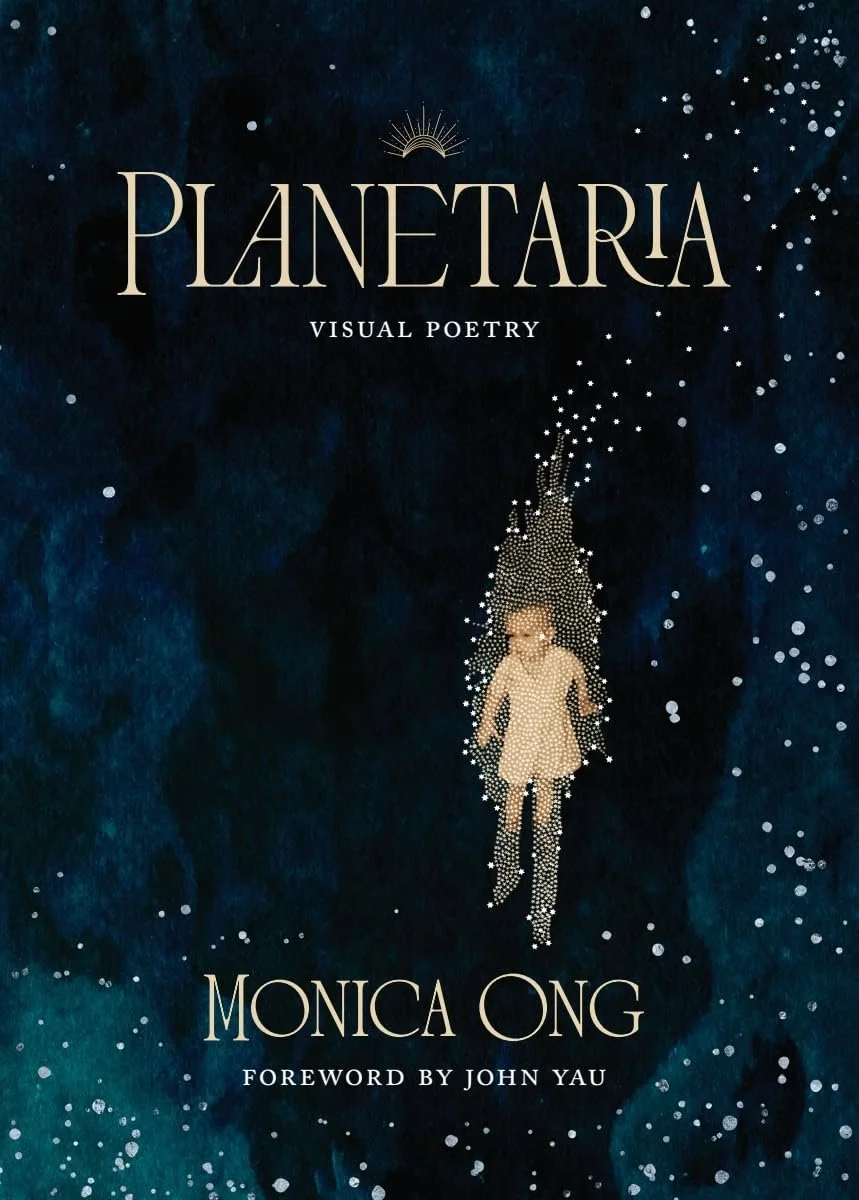
Last year at AWP in Los Angeles, I moved from table to table asking whether literary magazines accept visual poetry or interactive poetry installations. If they do, I was curious to see what those pieces looked like and how the literary world perceives and makes space for them. Yet most of the representatives told me they rarely see anything quite like what I was describing.
Since the beginning of my MFA, I’ve been drawn to form, the quiet architecture of a poem, the way structure can meet the eye as a visual register before the language fully unfolds. Perhaps one reason is that this constellation of imagery grows from the linguistic soil of my mother tongue. Chinese characters are inherently pictorial: each character begins as an image. In their earliest forms, carved into oracle bones, these written signs still carry the memory of what they once pictured. This pictorial origin is more than history; it is an invitation. It asks us to read writing not only as language, but as a space where signs gather, transform, and break open into meaning.
Visual poetry has long carved out its own terrain within the literary world. Concrete poetry, at its weakest, can become overly declarative. Its form reveals its purpose too intentionally and closes it on itself, until the act of reading collapses into a single, prescribed line of motion. For me, when another element enters the form of a poem, it should help the reader perceive something the text alone cannot uncover. Diana Khoi Nguyen’s triptychs in Ghost Of teaches me to see how grief moves through a narrative space that cannot be taken away, and how the poem’s emotional force emerges from the spatial silences spanning the page. Similarly, in Mai Der Vang’s Yellow Rain, when the vertical bar replaces the traditional line break, the repetition of poisoned objects and the listing of symptoms and deaths create a cumulative, breathless urgency in the reading. In Planetaria, Monica Ong opens a new frontier of poetic space. Individual lives appear as particles in the physical world, reaching toward the stars—toward something larger and more cosmic than ourselves—yet still held together within the field of the page.
One of the most arresting gestures is the poem’s rendering of family memories and history through a cosmic lens. It is the first time I have encountered a poet who renders family history as a trajectory, a point observed within a coordinate system: “the hundred eyes of my ancestors—still waiting for justice—gaze back at me”. In this opening poem “Lavender Insomnia”, time elongates skyward, thinning into a vertical reach toward the infinite. While sky-gazing in Western traditions often suggests romance or wonder, the intrusion of family photographs overlaid with scientific diagrams unsettles that impulse into something more archival, more exacting. The natural cycles of the cosmos recede, and grief endures vast, unspooling, almost astronomical in scale. The speaker’s gaze flickers as a small particle in this vast field, revealing how fragile we are before forces far beyond our control.
When I first encountered the opening pages of this book, I felt compelled to step outside and linger under the night sky, trying to imagine how it might wrap around us, the way the poem once unfurled itself in an immersive space at Yale. In some English poetry, identity often emerges through self-interrogation, through the turning of the mind upon itself. In many Asian traditions, however, identity takes shape through relation: family, ancestry, and lineage. In the poems that follow, Monica Ong situates family photographs and genealogies within cosmic structures: the Milky Way, the slow orbit of planets. Words scatter across the page like stars. As a reader, I imagine them straining toward one another, like hands searching for other hands, yet the layout keeps them poised in separation, so that longing lives on in the space between.
The lines borrow the language of astronomy, where what we see in the sky depends on latitude. Here, that coordinate becomes intimate: a latitude of longing. From this vantage, the world begins to fall softly by degrees: snowfalls, the remembered warmth of touch in open palms, the drifting fog of death, even the heavens themselves slipping just beyond sight.
Before I began this book, I happened to read Purity and the Avant-Garde by John Yau, who also provides the foreword to Planetaria. In the essay, Yau questions the authority of the term “avant-garde” in formalism, arguing that its borders have long been drawn and policed by white critics and cultural institutions who determine artistic legitimacy and lineage. Within this framework, writers of color are often left to hover at the margins: either to remain outside the tradition entirely, or to be admitted only as “the exceptional exception.” Reading his essay returned me to a question that has lingered with me for some time: what distinguishes visual poetry from other formal experiments, like contrapuntal forms? Can visual elements enter the body of a poem so seamlessly that they become one with language, organic, inseparable, necessary, rather than an ornament around it? After reading Planetaria, I believe I have found an answer.
In “Blood Moon Woman,” I experienced Monica Ong’s radical reimagining of both theme and form. The poem draws on lines from the famous Tang dynasty poet Li Bai’s “Quiet Night Thought”, whose final line reads: “Then I look down and think of home.” When I was young, the poem was offered as an expression of patriotism. Yet I always sensed within it something more complicated: a sense of displacement, even a faint, imperceptible loosening of the self. Li Bai, influenced by Daoist thought and a life of wandering away from his place of origin toward the Tang capital, often wrote in a state of suspension. His homesickness is not simply for a place, but for a place—and a memory—to which he can never return. Monica Ong extends this diasporic condition into the female body, placing a dominant blood-red moon at the center of the page, where female identity itself becomes a celestial body. She imagines the growth and transformation of the female body through a language that is both intimate and scientific, as if the image discloses what circulates beneath the skin. Although the lines are arranged in a grid, we can almost feel their motion, revolving with the moon as streams of blood.
Another striking force of this book is the way mathematical diagrams enter the poem and become part of its narrative architecture. In the poem “Book of Vera,” Monica Ong turns a triangle to retell the story of the astronomer Vera Rubin, who was allowed to enter the field of scientific research but was denied something as basic as access to a women’s restroom in the observatory where she worked.
In the second stanza, Ong ushers us to enter a geometric space as the starting point of shape and to pressure an argument. The “first point” is no longer merely a point in an equation from which a field is measured: it also becomes the solo point from which one must begin unaccompanied. The poem then introduces the mathematical term “pivot,” which functions both structurally and emotionally as a trembling hinge in the poem’s emotional movement. It becomes a metaphor for the labor of turning oneself toward visibility, recognition, and dignity within a space that was never designed to accommodate women.
The triangle itself is significant. In mathematics, it is often considered the most stable geometric form. By juxtaposing this stable structure with the image of “spirals of testimony,” Ong introduces the ongoing struggle of women, particularly women of color within scientific history. At the end of the poem, when the line declares, “There you go; now you have a ladies’ room,” Ong inscribes the image with a vertical line bisecting the triangle. This line reads at once both a geometric axis and a line of sight. The gesture carries a sense of humor, yet its quiet ferocity claims how equality must sometimes be drawn, literally and structurally, into spaces where it was never intended to hold it.
In Planetaria, Ong redefines reading and seeing as intertwined acts, treating the page as a visual field where text and scientific imagery are materials for new lyric possibility. This book also asserts that writers of color and women poets are capable of innovation, and sometimes, can make it with exceptional originality and reimagine the limits of the possible.
Chris Du is a poet born and raised in southwest China, where she grew up in the mountains and writes poetry in both English and Chinese. She is also a translator of Sylvia Plath and contributed to the Thousand Languages Project at ASU. She is currently collaborating with scientists and visual artists on a visual poetry project. Her poetry explores ecopoetics, myth, and memory. Rooted in classical Chinese traditions yet written in a contemporary lyric mode, her work dwells on questions of presence, language, and the human relationship to land and loss.