ASMR at the End of the World
These cold mornings I am the first to get out of bed. My bladder is killing me, my mind as ragged as unbrushed hair. I leave the chamber pot for later, stir the coals in the fire downstairs, and step outside. Up the hill, the goats are waiting for me in the barn with tight udders, listening for my footstep so they can start yelling their goat obscenities. Once that happens, the day will have begun, and I am not ready for their bullshit, or anyone’s. I walk behind the house, trying not to make a sound. All around me, the fields are grizzled with frost, the dense dips and vales are bright where they should be shaded. I know that the sun will rise soon, and the white shadows of the trees will cling to the grasses, the fine melt lines so clean, it almost makes too much sense. Hurts my heart. Everything does.
At the ditch, I hug my skirts away from the prickers, but I can’t help but admire their bloodless purples, the delicately sculpted thorns; more proof that nature isn’t fucking around. No needle of precision spared, even when there are so few of us left to see it. The other day, one of the cats puked up a mouse head, and there was its eyeball, threaded by a neuron of bright red. I thought, the darkness will reveal her palette, and it was one of my better thoughts that day. I squat and my piss sears the cold ground, stinking exactly like last night’s onion soup. I think of the man still sleeping in my bunk—our new Reaper Boy. I think: These are my last years getting laid by lonely, curious thirty-somethings. And he’s probably only fucking me because he thinks that my age makes me Fam matriarch and I will favor him. Or maybe it’s the thrill of the freebie— assuming he knows that I am too old to get pregnant. Assuming his last Fam taught him the basics, which is unlikely. No one knows anything anymore. It’s wonderful in the way that a fire grown uncontrollable is wonderful. The way the hidden quarry behind the farm, filled with the sunbaked bones of deer and cattle, is wonderful.
*
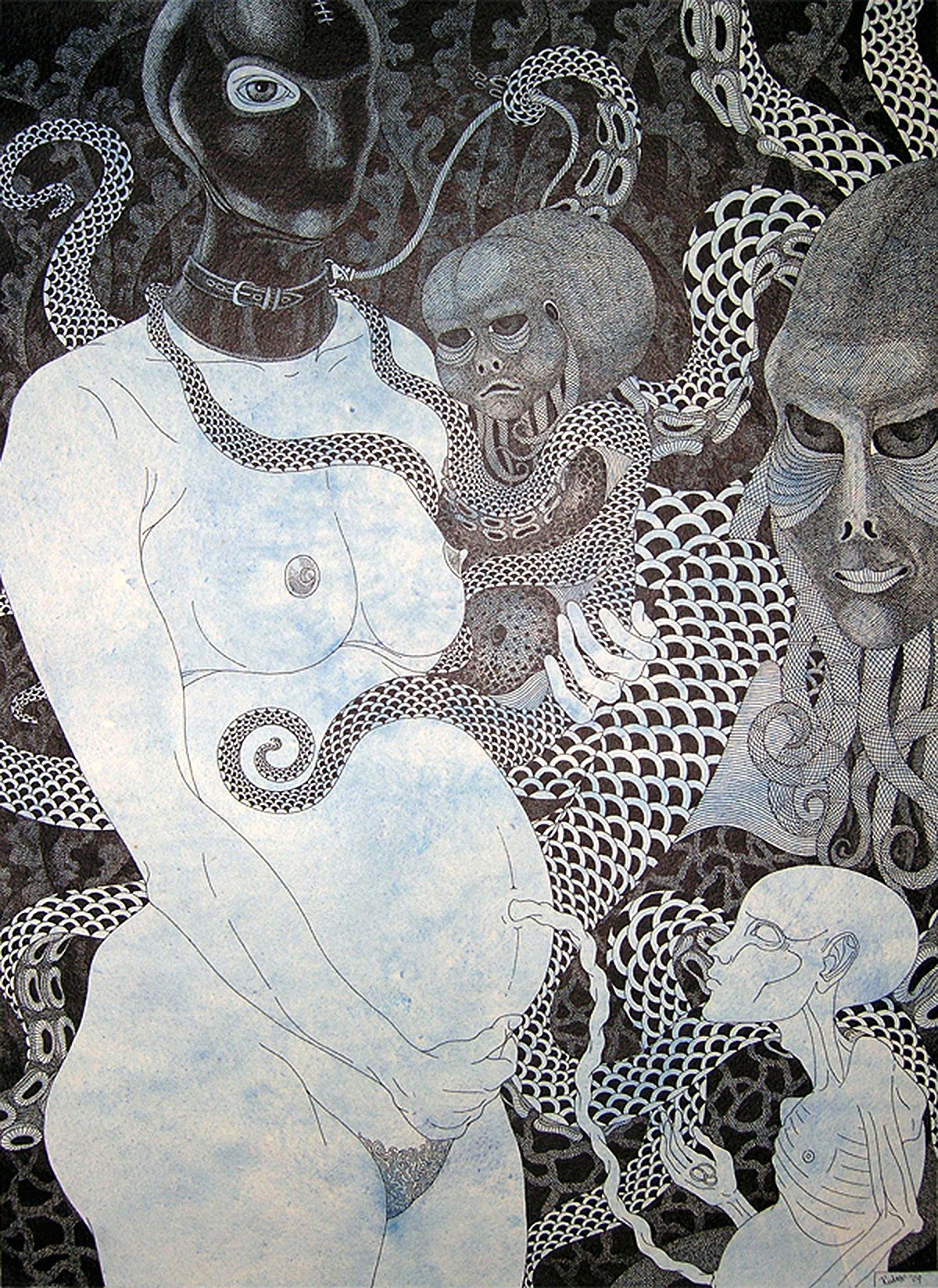
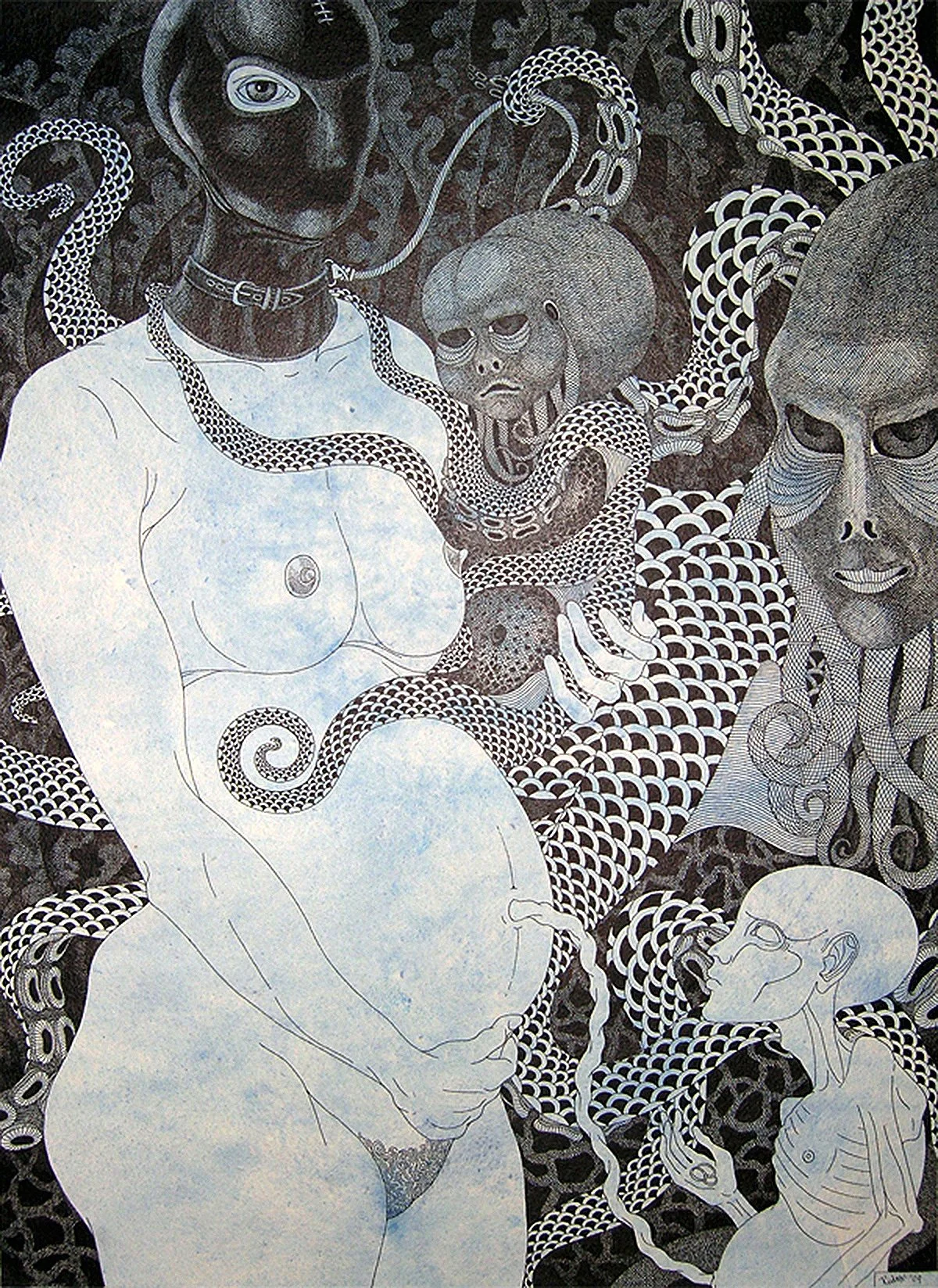
Apocalypse by Rudra Kishore Mandal
I remember the first time I felt it. I was four years old, sitting beside a boy named Tony Geannelis on a mound of cushions at the library. Tony and I both wanted to read the same book, so we were forced to share—Tony in charge of turning the pages, even though he pawed them clumsily. This page-pawing combined with the sound of his moist sniffling had a crude but also brain-liquifying effect. I cannot properly describe the depth of drunken pleasure that I slipped into sitting next to Tony, his movements—his raw presence—washing over me, bringing every follicle of my being to dreamy erection.
I call that “ASMR in the wild,” but it can be manufactured if the conditions are just right, if the artist is truly inspired. Chelly is the best we’ve ever known. Our darling most precious Chelly Bean, Belly Bee, who came to us as a pre-teen with wild Janis Joplin hair, and a sliced kitty cat smile. Her talents were immediately apparent. She was radiant with calming, benzo-quality energy, wearing birchbark scrolls on her forearms, clicking her tongue against the cleft of her mouth when she was deep in thought, which she always seemed to be. Or not deep, but distant, and that’s why the hairs on our bodies lifted when she walked by. The sticks snapping beneath her feet a selection of finely tuned bones. It was unanimous: Protect her at all costs.
*
I’m crouching, wobbling, as if I haven’t used these same muscles to piss in the bushes every day for the last two decades, when I feel the little tug on my shoulder. So gentle it might have been a thorn snagging my shawl. I turn and see Baby Soup huddled small in the brush, underdressed and pimply with cold.
He watches me wrap my skirts, his mouth a twisted smile of dirt and crusted blood from his nose. The poor boy looks like he has been outside all night. He opens and closes his white fingers, which means that he wants something: food, maybe, or a kiss. Someone to hold him, take him to see the mommy goats. There’s a ball of dried burrs tangled in his long hair.
“What you wan, Lil Soupy?” I whisper. I’d like to say that I only baby talk real babies, but in our Fam, we all baby talk everyone. We don’t even notice anymore. Sometimes I think that we just want to be more like Chelly: plushy cute and sensitive, saccharine and witchy, lisping ourselves into a groggy honeydew heaven. Or maybe everyone in the world talks baby now, and I just have no way of knowing it. A symptom of a culture where there is no authority, no booming principal reading us the football schedule over the intercom. I finger the burrs in Soupy’s hair.
“You wan beebees?”
And I can see in his eyes that he does.
My own boys had heaps of books—every week a new batch from the library, glossy with pictures of other babies, the more diverse, the better. My youngest called them “beebee kooks.” Baby books. He loved to trace his finger over the faces of the ordinary boys and girls doing ordinary tasks, playing with ordinary toys, like wooden ducks on wheels and wooden trains. His favorite page: a photo of an orange-haired child wearing a colander as a hat.
“Les have a looky,” I say, taking Soupy’s ice-cold hand, and leading him out of the ditch, forgetting all about the goats, forgetting about New Reaper Boy in my bunk, who I’d baby talked all night. Lemme feel that fat dick, cutie. You gotta fat dick for a cutie pie. You got a cute face for a Reaper Boy. And he liked it well enough. From the corner of the room, his sickle was a candlelit moon, brushed with our shadows.
Baby Soup follows me into the covered porch, where we navigate the ceiling-high stacks of firewood, slipping between the wood and the wall to a corner where some cats are sleeping. They purr when we come close without opening their eyes. It smells like their piss back there, but it’s too cold to stay outside, and I don’t need anyone else knowing about my beebees. We sit. Soupy folds himself onto my lap, like I am his best and most trusted mother, and I admit: sometimes I believe that I am. Maybe we all believe it. None of us in the Fam have our own children, so we put our love in him, like he’s our love soup, this baby, now little one. We pretend that it’s safer this way, as if we are not the kind of parents that we fear, the kind of parents who would burn everything down if only to have their offspring outlive the world by a day. I peel open my layers, fingers into my inner pockets, and pull out the folded papers. They are milky and creased by years of handling. Soupy grabs at them, but I am afraid that they will tear, so I hold his arms down, dangling the page in front of his face. He makes a grunting sound of appreciation: his beebees are back. I wonder who was on Soup duty last night, hoping I’m not the one responsible for neglecting him, letting his nose get so cold it cracked inside. Although, reverse-cowgirling the new recruit all night wasn’t a wholly selfish act. We knew that we needed him, and he appeared just in time for the harvest, walking the river trail, his toolkit draped over the back of a giant black dog. It
looked like a Newfie to me, and my first thought was: guard dog. We need a guard dog for the chickens and the goats. But the others had their sights set on the glinting crescent moon that he had slung, messenger-bag-style across his chest. The last guy to leave the Fam took all his farming equipment along with him. And, in a cruel act of bitterness that we had never sensed in him, he had smashed all the mirrors in the house. How we mourned those mirrors, even the old-oldies, like me, because there was no news left in the world, nothing even reminiscent of objectivity, only rumors and gossip, and thin veins of smoke in the distance. How would we know ourselves to ourselves now? Our faces stretched into a backbend on the side of a brass urn? Across the trippy onion of a doorknob? Some of the youngers took mirror shards back to their bunks and rigged them to the wall. I catch them studying their pores in the mornings, not like teenagers of the past, but like the teenagers of now: vain as shit, but also seeking, bewildered.
Soupy came to us as a baby carried on the back of a raving mother. She wore sunglasses, which many of us had not seen in ages. The effect was startling, like looking at a futuristic wild woman, a punk city hag. She had foul dark stains down to her knees from where her breasts were leaking. It seemed that motherhood had driven her mad, her infant tied to her pack with his arms out, crucifix style, blinking silently. It pained us to see his arms spread when we all knew at our core—even our most clueless and childless—how babies ought to be swaddled.
“Give the baby your milk,” I whispered to the woman. “I know it hurts, but you must.” And she sucked her lips over her gums and launched a putrid berry of blood and mucus at my face. We untied the baby and fed him goat’s milk with
the corner of a rag, and then, when his mouth was big enough, we let him nurse directly from the does on his hands and knees. For three days, his mother wandered the perimeter of our farmhouse like a rabid animal, before falling into the quarry, breaking her body over the other bones. We did not pretend to feel anything but relief.
Baby Soup grew and smiled at us and learned to eat and walk and climb, but along the way, we must have forgotten that it was also a child’s right to learn language, to babble and coo. To ask, “What’s this?” It’s my understanding that he sensed in us this oversight, and was not encouraged to learn, and therefore never did. As if we are products of the world’s expectations, just as we are products of love, or cruelty, or in Little Soupy Poopy’s case, his caretakers’ void of verbal tradition.
The sun is up and showing through the windows of the covered porch. The same morning sunlight that used to blind me on the roads as I drove the boys to school. Halos of blindness around a flashing school bus, the children boarding in single file, strands of hair splayed golden and crisp. At the same time, I’m having a vision of my own name tag taped to my desk in first grade, smacked into focus by the early October sunlight. The pen nib gliding against a rubber eraser, drawing an inky face so the pink square could be my baby. Keep the baby safe in my pencil box.
Now our body heat is making the windows fog and from outside we hear crunching footsteps. The slim sound of a girl’s voice. Soupy looks up. The sleeping cats swivel their ears. I fold the paper and put it back in my pocket. There are people beyond the glass.
Eavesdropping is a sacred tradition here, perhaps our only defense against upheaval, mutiny, all the hundred forms of betrayal that could destroy us. Old Reaper Boy, the one who broke our mirrors when he left, was guilty of wanting the wrong thing, yes. But what got him in trouble was forgetting to hide his desire. Forgetting that everyone is watching everyone, looking for the signs. We couldn’t let him have her, we said in whispers, when what we meant was: We cannot lose her to love.
You must understand that we are a relatively feeble crowd. We live in a giant farmhouse already fortified by past residents, with a small established farm that produces just enough milk, meat, eggs, vegetables, and herbs to live on (the fruit trees provide on their own terms). We keep the goats pregnant. Keep the fire lit. We pick wild mullein to wipe our asses. No one plays music, and drumming drives us to unnerving mania. We are nothing like the postapocalyptic warriors of the old-olden day TV shows.
And yet.
We managed to design and construct our own amphitheater, aided only by the natural rock formations along the quarry. Inside are tiers of wooden seats sanded by hand, reclaimed candelabras, a boxy stage. Outside, a pitched roof. We did it all for Chelly, to give her the stadium that she deserves: her own platform for sound and shivers, where she can perform onion-braiding tutorials, or wordless stone-sorting demonstrations. Once, she taught us how to weave a bonnet from reeds, and we sat, transfixed by the slender bending and whispering, the quicksilver of her tongue, for so long that, when it was time to stand and walk back to the house, we all fell over, our legs and feet dead
asleep. The amphitheater is our schoolhouse, our church, our place of gathering after long, sunburnt days and flea-bitten nights. Chelly, Sweet Chelly, is our reward for staying alive.
The voices outside the porch are quick and hushed, which makes me even more eager to listen. A man ironing the boom of his voice into tenderness. A cricket-like reply. Dimples of uncertain laughter. And just as they begin to move closer to the house, where I might hear them better, Little Soupy reaches up to drag a finger through the fog on the glass. It makes a squeegee sound and the boy laughs in surprise. The voices outside stop. I can see a pale shape move swiftly out of view.
*
I was newly divorced, living part-time with my boys, when the rumors started. Everything happened so fast that any news we could obtain was just news about the speculation itself: something about evacuations of northern territories. A new virus released, the first one having just been a form of conditioning, grooming us for complacency. Power grids being hacked. It didn’t matter what you believed; people started prepping. It didn’t matter if you considered yourself above the rumors; others were prepping and so should you. By the time we started to figure out the truth of what was happening—what no one had predicted, of course—it was too late; even if there had been systems in place to help, we would not have trusted them. We trampled our own escape route.
I got the call from my ex-husband early on a Saturday saying that he was taking the kids to his family in Quebec. He was standing outside the car where the boys were already buckled and ready, wearing their BMX helmets, he said. Their idea. He tried to chuckle. He didn’t want me to hear the fear in his voice.
“Come with us,” he said.
*
“But I had a neighbor who was on oxygen,” I tell New Reaper Boy, who has found his way into my bunk again. “That means she carried a tank of air with her to help her breathe. She needed to take big pills every day so her body would not spit out her new lung.” I stop talking so I can put my mouth around him, so he can be conflicted between the urge to get hard, and the urge to ask me what I mean. It’s my job to keep him conflicted because I still think that, in some instances, confusion is the securest route to loyalty.
“New lung?” His words are deliciously strained.
Geraldine’s visiting nurses had abandoned her. Her oxygen delivery was late. When the pharmacy van stopped coming, I walked to pick up her prescriptions but found a sign on the door, blaming a staff shortage with unsettling benignity. Geraldine was the worst rumor-believer that I knew personally, but she had no one, except a shabby trio of birds in poorly lit cages. Her apartment was below mine, and I could hear them squawking when the
windows were open. The parrot liked to say, oh fuck me, in a low dejected voice, and when the boys were here, they lived for it. In the middle of a quarrel over video games, the weary mouth-full-of-sand voice would come through the floorboards—oh fuck me—and the boys would slump over, faces frozen with laughter.
It’s why I was sympathetic to Geraldine’s case even when she was hard to deal with—because those early days of the divorce might have been much worse for us. Those failed dinners in our flickering kitchen, the brown sputtering faucets, all seemed a little less aggressively hopeless, and more like a parody, with that awful bird running commentary. Like the boys and I could see ourselves in a new storyline, instead of the spiral of uncertainty and dread that our life wanted to be. Towards the end, Geraldine was convinced that her birds were picking up top secret radio signals in their beaks.
“Hear it?” She asked me, holding up her cupped hand. The lovebirds by then had plucked all their feathers where they could reach. They looked like wry puppets, indignant, with a terrible pimple for a butt. One of them croaked out a long sequence of blips and growls, like an old-school internet connection. I didn’t know what to say to her. The birds were obviously dying.
“Her birds could talk,” I tell Reaper, laying my hand on his stomach. There is a nugget of hair and dirt packed into his belly button, but I stay out of there. Not my place to be his mother, I think. He arches his back, his body angling for more.
“Now you’re just shitting,” he says.
“I am not. You never heard of parrots?”
He places his hand on my head, angles himself again. Please, his body says. Stop talking.
“Long, long ago, if you had a bad lung, they could take it out and give you a new one.” I straddle him, not giving in to his writhing. I need him to understand this one stupid thing about the world that I came from.
“How did you know if you had a bad lung?”
That’s good, I think. Give me your wonder.
*
After the voices from outside had faded, I led Soupy from the front porch into the kitchen, where Benjamin was at the fire, boiling water. Benjamin is basic, with a basic name, and a basic history, so I like him. He says that he used to be a chess master, like that’s all we need to know. Once, when he was fucking me against a tree in the orchard, he confessed that he didn’t know how to feel love. I said, It’s fine. I said, That’s probably why people trust you here. I shouldn’t take it personally that we don’t have sex anymore, in the orchard or
anywhere else. Not like he’s chasing any of the youngers. He’s depressed. It’s obvious. When I left the kitchen, he was watching the woolly shadows judder on the wall, while Soupy sat on his lap, hiding acorns in his beard.
When I’m with New Reaper Boy, I miss men like Benjamin. Wrecked men who remember that sex had a culture built on shame and guilt and sneaky titty shots on TV. I could feel it in him—whether he knew how to love or not, it didn’t matter: there was that old thrust of good misery. The thirty-year-olds don’t get it. Their imaginations are as untouched and unnuanced as their hard little bodies. I can feel Reaper about to come, so I stop abruptly. Someone has to teach him to wait, to heel. To hate himself just enough to make it good.
“There were doctors who could look inside you,” I say to him, trying to be vague enough to give him pause. “They could see if any part of you had gone bad.” And I make like I’m going to put an ear to his chest. “Want me to try?”
“No—” he says. He nearly falls off the bunk in fear.
*
I’m awake early. This time to milk the goats. The world, once again, has the audacity to be sparkling and unseizable. Seedpod silver and shades of soft resilient purple. Dried and curled and split in infinitely surprising ways. I hate to be boring in my awe. The plunging into despair, the plummeting into beauty, reluctant witness to the perfect glowering of nature. In the barn, my cold fingertips find an unruly doe with a swollen udder. I secure her head against the wall with a contraption made from a forked branch, wipe her teats with the end of my skirt before squeezing them into my jar. I am not above craving Chelly’s gifts, wanting to be near her, in her reedy shadow, her fingernail-
clicking aura. Tonight, the Fam will be gathering at the theater for another demonstration. I heard that Chelly is going to ask for a volunteer again, which is almost too much for any of us to take. Last time she did this, it was for a louse-picking lesson and she selected our old Reaper Boy, who had a perfectly shaggy head for it. Old Reaper was young, like New Reaper, but more withdrawn, more Kurt Cobain, less Coors Light. The kind of guy that might have been an artist or an actor in a more privileged time. He could fix anything, rig any trap, swing a sickle all day, and we patted him on the shoulders and fed him extra servings to keep him strong, but you could see that the praise did not touch the part of his soul that wanted to thrive. Our encouragement was like pouring water on a beached whale, prolonging his agony, when all he wanted was the sea to come and take him for good. The sea of what, I do not know. But I caught a glimpse of it that night from the first row, watching him bend for Chelly’s fingers. She raked them against the grain of his neck, then separated his hair into white lines to be inspected for insect eggs. Old Reaper had let out a harried groan of relief, something that would have been too intimate, if we had not all been feeling it also. We slumped, we released a collectively held breath into the chilly theater, some of us unable to stop ourselves from running our fingers through our own hair, pleated as we were in layers of pleasure.
The problem with the amphitheater is that, by building it, we inadvertently created an institution. Institutions must be upheld, or else their collapse represents the collapse of a society. We know this all too well. For this reason, a small council was formed. We met in the cramped and mouse-infested dry storage lean-to, so that we didn’t start mistaking ourselves for VIP. It was Benjamin, a short woman called Sugar, a high-strung younger named Geek, and me. We brought Chelly in for a chat, gave her a big gourd to hug while we lectured her on the dangers of giving private, off-stage demonstrations to Fam. How it shows favoritism, causes rifts, even when her intentions are pure. We
waited to see that she had understood, watching her one thoughtful finger tap the firm surface of the gourd, the sweet sound of it breaking our innermost membranes like rain on water.
“He really had buggies in his hair though,” she said, still tapping, a serene and sideways glaze in her eyes. It calmed us. Benjamin stood, patted his stomach like a man who had momentarily forgotten that he wasn’t fat, the gruffness in his body language conveying what we all knew: We could not police her. But we could watch her. And we could watch Old Reaper.
It was an anxious time, the dry storage council trying to sour a love affair before it took off. I admit that I went along with it eagerly, because I was worried about my standing within the Fam. We’d had a bad year with the goats, which were mostly under my watch. In a span of eight months there had been a rise in incomplete births, mastitis, fungal infections. And a strange set of twin kids born hairless and hard as stone.
“A big, bad sign,” Sugar said, and I told her not to bring old superstitions back into fashion.
The light changes in the doorway of the barn and there’s Baby Soup, waddling toward me, his long clothing sour with urine. I unhitch my doe and send her back into the straw with the others. Pick up my warm jar of milk. Soupy has his hands out, opening and closing his fingers in his sign for want. I know what he wants, but I give him some milk on my finger first. He sucks it like a baby, all instinct, no expression.
“You needy new clothes, pee-pee boy.” He paws at my skirt pocket. “Not now,” I say.
Superstitions have been raging, so much that, this summer, some of the youngers went up to the quarry and tossed in a bunch of weed bundles. When questioned, they said that they had tied the blue flowers together as an offering to the bone spirits. Sugar told them to do it after one of our men died from a bad infection. In his fever, he had claimed to see a hollow-eyed horse leaping into a hole.
“You do realize we are all traumatized,” I said to Sugar, trying to account for the fever hallucinations. “I see worse shit just closing my eyes to sneeze.” But Sugar said that the man’s horse vision was bad luck. Wait till I tell you what breaking six mirrors all in one night means, I wanted to tell her. But kept my mouth shut. Soupy is smacking his lips. I offer him another drop of milk, but he keeps smacking, so I lick it myself. Now that the goats don’t spend all day outside, their milk is starting to taste duller, peaty, less sunlight and wild herbs in it. I can’t taste anything, though, with the smell of piss wafting up from Soupy’s clothes. We need to do better by him, but I don’t want to be the one to say it. Can’t risk exposing myself as more mother than the rest.
“You lie down in that straw, mmkay?” I point to a damp heap beneath a boarded window. It stinks too, but I figure the child is already disgusting. Might as well go all in before I bring him back for a change. Like how I allowed my boys to run through puddles in the grocery store parking lot if I knew they were getting a bath that night. Soupy obeys, toddling over, then lets himself
land face first in the heap. An adolescent doe kneels to inspect him, nibbling at the burrs that are still tangled in his hair. I think, That should keep both of them occupied so I can fill one more jar. And that’s when I see them through the door. Far out by the tree line. So far out that they would have no idea that their outlines are positioned directly in my view, framed and centered. To them, the barn is a gray block with a wide black door, filmy and unstable with the sun rising behind it. My eyes are tearing with trying to focus on their faces, which from here are mere sparks. The sparks wobble like drops of water. Their bodies flicker like blue flames. And then they are gone. Slipped behind the dark pines and the tall red bushes. I should mind my business, grab another doe and squeeze her dry, but there’s a bottomless feeling in my heart now—a naked part that I can’t wrap my skirts around to cover. Sometimes I dream all night about the grocery store. Dream all goddamn night that I am walking smoothly up and down the aisles in sturdy heeled shoes, pulling items off the shelf with my finger and thumb, like everything is the same sleek and uniform paperback. Boxed taco kits, boxed cereal, boxed fruit snacks for school, boxed mini beef jerky sticks. These dreams don’t fill me with longing for better times. They make me furious. So many years feeding my children corn syrup and red dye and marshmallow candy bars that claimed to be dipped in yogurt, because I loved them. Years of being coddled by R.E.M. and Madonna dripping thinly in the background. Feeling good about myself for choosing an unspoiled onion, for getting the plastic bag open without swearing. All these moments a kind of terrible preparation. A mother is such a pillar of a word, but all the mothers I knew were as scattered as corn silk when it came to the most important decision of their lives.
Oh Soupy, I’m sorry, but I am walking through the barn door. I am going to find out who those people are in the trees. They could be strangers, scoping the property. They could be our own, planning a midnight egg embezzlement. Maybe they are just young lovers looking for a semi-risky fuck. It’s hard to explain how much I don’t care what they are doing and yet how driven I am to act.
*
Anything could have always killed you then, but truly anything can kill you now—the possibility of unmedicated death trembling before your every decision. The panes of glass will rattle in the old windows if you don’t tiptoe. The rocks will slide into the quarry and clack with lovely sharp echoes if you stand too close to the edge. I know I should have let New Reaper come in me instead of scaring him with stories of organs going bad. Letting him come would have secured one more stitch of loyalty in this big interpersonal knot that we live in. I might have gained one more temporary ally. Should have picked the junk out of his belly button like a good woman, could have started a whole new cycle of generational expectations, once again placing the burden on us to keep things in order.
The grasses are slick and cold against my legs. My breath a steam engine. I must look like a big stained and billowing ship of female meddling, plowing as I am through the field. I am smart enough to know that I am not chasing the two sparks. I am chasing the old ache. I must keep chasing the ache. Keep
surviving, keep pushing myself into inner circles, joining dry storage councils. Keep fucking the new guy. I reach the woods where it is quieter, a springy covering of pine needles muffling my steps. The trees out here are stately and half-stripped of their bark by porcupines, the closest things to sharpened pencils that I’ve seen in years. Through the cloud of my breath the two figures are now visible, and I am stunned to see them, as if I had not expected to find them, not really. They are still far ahead, but no longer sparks. I can see their long loose clothing, can see them pressed together. A pair of horny kids, I think, foolish enough to venture out in the frost, risking poison ivy and quills, because they’ve never had a real secret in their lives, never felt the tattered edge of something unwholesome, like the cap of an unidentified mushroom tucked into an inner pocket. The power that it may or may not hold. And as I am thinking this, I am placing my palm for balance against a tree and right into a glob of sap. Fuck me, I want to say.
*
“Hear it?” Geraldine wanted me to hear the blips and squeals of conspiracies broadcasted through the beaks of her birds so that we could be terrified together. Before that, my oldest boy would shovel her walkway, carry her packages inside for her. I remember how packages used to pop open and spray the floor with the delicate patter of foam peanuts. Foam peanuts will never decompose. If I could find one, I’d press my thumbnail in it to make a mouth. I would give it to Little Soupy, tell him it’s a baby, his very own.
*
“My neighbor is on oxygen,” I told my ex-husband over the phone. “She’ll die if she can’t get her pills or her air.” I’m still thinking fuck me about the sap on my hand, fuck me about the grocery store dreams and poor, urine-soaked Soupy getting his hair nibbled by goats. Fuck me about Chelly’s thin face staring at me through the trees in shock, but also not shock, because of her secret
divinity, her snaggle-tooth high priestess calm. What is Chelly doing in the forest? This thought is louder than the next, more important, question, which is: Who is that with her? As if he’s heard me, he turns and our eyes meet. Mine stupid and caught. His saying, You thought you could control me, you old bitch.
Now would be the time to let the world fall apart again, to go back to my goats, the dirt-covered boytoy in my bunk, while I still have him. Go find a landfill and fish for Styrofoam peanuts, give Soupy his own private Christmas. Here, take all these babies and keep them safe.
*
“Keep them safe,” I said to my ex-husband because he had always been an asshole, and I could see now what a wonderful gift that was going to be. He would fight and loot and hoard all the canned goods and antibiotics. The boys would survive with him.
*
There is a held moment in the quiet of the forest. Our acknowledgement of each other as fresh and shimmering as dew. Then Old Reaper, whose Cobain hair is longer and whose beard is darker and snarled, but who is otherwise the same as the last time I saw him, takes Chelly by her arm and pulls her into a run. I feel the pine needles slipping beneath my feet before I understand that I am running too. I cannot let him take her away from us. The institution. The tingles. The future. There is pine tar and spongey decay in the air. My chest is bright with oxygen, and I am running harder than I’ve ever run, the pores of my lungs as strained as mouths. Like Geraldine’s screams when she found her birds dead: white scrotal lumps on the bottom of the cage. She couldn’t even see her own doom because it had gotten so close that it was out of focus. Our apartment building thrumming with flames before I could go back in to save the photos of my boys. When I could have secured them days before. When I
could have told my ex-husband, “Okay, I’ll be there as soon as possible.” Thinking to myself, I’ll start driving to Canada now then finding my car siphoned dry. The sound of shouting and glass breaking somewhere close but still not real. Still like someone else’s problem. Dialing my ex and getting that strange recorded message rattling off emergency sites for locating lost family. Disconnected. Unavailable. It didn’t make sense to me.
*
Somehow, we have run perpendicular to the path that leads to the amphitheater. I stumble onto it, into the subtle rift of light. Chelly and Old Reaper are no longer in sight, but I follow the path upward by instinct. They will be in the theater, where it all started, I think, although it seems too obvious. There’s something I am missing. But I pick up my skirts again, breathing against the crackling fire of my ribs. I’m going at a soft, silent trot, hopping over slick stones, watching the way ahead. Chasing the ache. Chelly makes us human, I want to say to some imaginary court. Maybe to the tree trunks with their shivering pools of light, like tender but scornful faces watching me. Chelly is the tether between the good of Then and the good of Now, I want to say. The misunderstood of Then. The hallowed of Now. Her face doesn’t remind us of anyone. It’s cracked like a teacup, cleaved like a seed. I am a child standing before my mother, offering her wafers of excuses. A woman before Spirit, offering her a thin trickle of righteousness, like milk from the corner of a cloth. A page ripped
from a catalogue and kept folded in my inner pockets, upon which there are, in faded dry ripples, two boy models who are not my own children, but who look vaguely like them. Not enough to make my heart split when I see them. Just enough to reclaim the small groove where ordinary pain meets ordinary love. My own beebee kooks.
*
The path levels, becomes stonier, almost cobbled, like a real road leading to our one real accomplishment. Of course, the theater doesn’t look like much from the outside, the roof a leaf-covered jutting of wood. The doorway low, leading underground. I stay for a moment at the end of the path where the trees open into the natural clearing, waiting for my pulse to settle from its whiplash. The sun fills every small nook and scroll of detail with glassy moisture. The colors slapped down, over-saturated and quivering like the lip of tears on your eye. Beyond the theater’s roof, there is a row of starchy shrubs and blackberry bushes. Some young birch whiskers and large, solemn boulders. You wouldn’t know that they mark the drop off, the sudden edge of the quarry, which is why, I suppose, so many of us have fallen in.
—————
GENEVIEVE PLUNKETTis the author of PREPARE HER: Stories and IN THE LOBBY OF THE DREAM HOTEL. A recipient of an O. Henry Award and the Sewanee Review’s Andrew Lytle Prize, her short fiction can be found in the Sewanee Review, The Southern Review, New England Review, and Electric Literature. Her second novel THE LONELY GIRL’S VEGETABLE PATCH is forthcoming from Feminist Press.