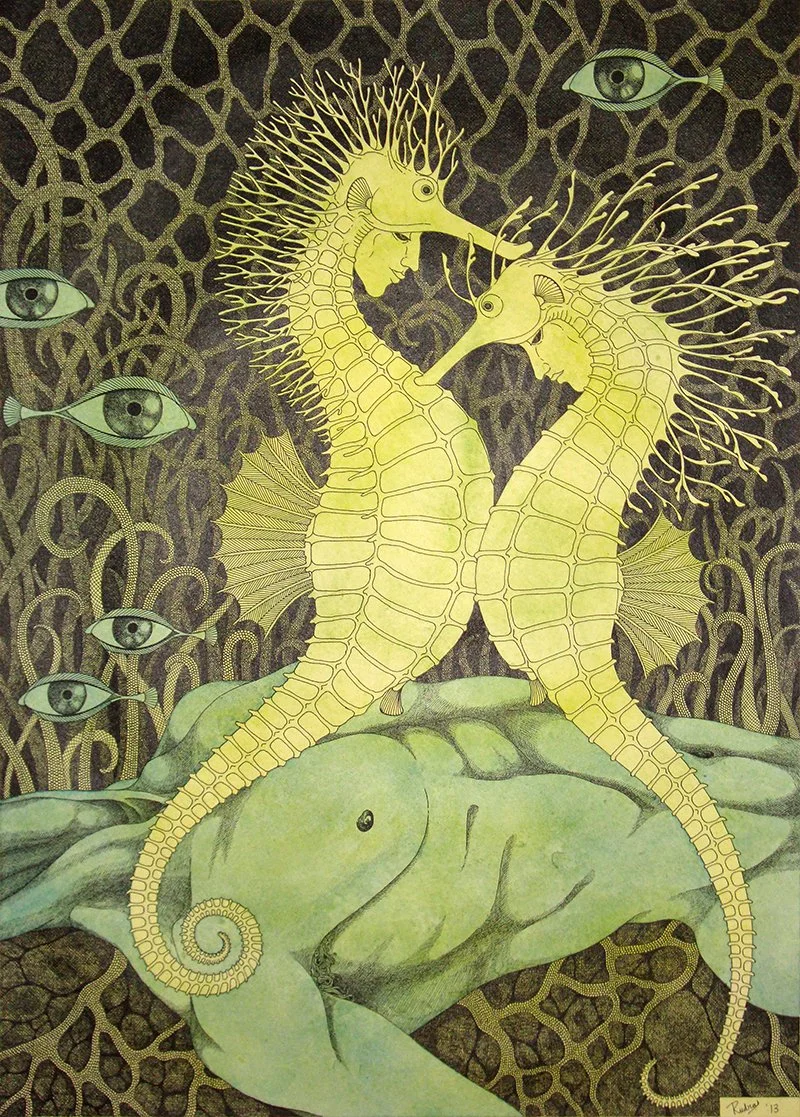
Tiny Hairs
1. Ears
Although I cannot see them, I’m told that my inner ears are lined with microscopic hairs, and that when these hairs are struck by sound waves, they transmit the vibrations as sound to my brain. It is when these hair cells are damaged that we lose our hearing, especially as we age, and these special tiny hairs do not grow back.
Apparently, using a cotton swab to clean wax, dirt, or water from my ear canal can damage these hairs, and I’ve been warned not to use cotton swabs too vigorously. I should only use such swabs to clean my outer ear. But the truth is, I’ve been cleaning my ears with cotton swabs all my life. Everyone does this, right? At least those of us with the “wet type” of earwax? Insert the Q-tip into the ear, twirl it around, remove it—now soiled with whatever wax, dirt, water it has gathered—flip it over, use the clean tip in the other ear, then drop the little thing into the garbage can. I was warned, of course, as a young person, that I must be careful because the cottony tip could be loose and become lodged in my ear, so I always check the cotton before I use it to be sure that it seems compact and firmly attached, without loose tufts or strands, but now I have been informed that the swab itself might be damaging my precious special hair cells. And I have certainly noticed that my hearing has diminished in the past decade.
And then there were my childhood ear infections. And earbuds, and lawnmowers, and noisy restaurants, and coffee grinders, and those little brightly-colored foam earplugs I jam into my ears at concerts or on airplanes. I have even slept with such earplugs crammed into my ear canals for more than a week of nights when I was staying in an apartment above a noisy, narrow street in the La Candalaria neighborhood of Bogotá, where voices bounced and echoed between the old stone buildings and tiled roofs all night long.
Oh, precious tiny hairs.
The Dance by Rudra Kishore Mandal
2. Frailejones
I was only in Bogotá for two-and-a-half weeks, but the city was my final stop in Colombia after I had been in the country for nearly six months. I watched a lot of public television during those months, mostly to absorb as much Spanish language as possible (without having to actually, you know, talk to people, because I am stupidly shy sometimes, and conversation was difficult, and sometimes humiliating, though I know, I know I would have learned more by wandering the parks and cafes and talking to anyone I could). But anyway, Colombian public television programming featured countless interviews with authors and musicians, musical collaborations, animated Grimms’ Fairy Tales, and travel shows, one of them featuring a fellow that traveled the world gathering stories of the stars—astrological, geological, folkloric. He climbed ancient structures in Mexico and watched the aurora borealis in the Arctic. And of course there was daily news.
It was on public television that I learned about frailejones, a word that means “big monk,” and a plant that grows in the Páramo, a high-altitude ecosystem of Colombia, Venezuela, and Ecuador. Frailejones have hollow central stalks, and thick, soft leaves that are covered with tiny hairs—like soft, dense fur—that collect rain, dew, and fog as it falls or drifts past. The leaves channel the water into the stalks that send the water deep to the roots, deep into the earth, where the water is stored for drier days. The plants bloom mostly with yellow blossoms that circle their stalks. To me, a North American, frailejones look like mulleins, which also have tall central stalks; plush, sage-colored leaves; and yellow flowers. But frailejones are much larger than mulleins. They are endangered because the glaciers are receding and because potato crops have been planted on much of the land where they grow. The loss of these plants—an indicator species—further diminishes water levels and availability throughout the region. On public television, I first saw frailejones on shows featuring people hiking in the Páramo, and shows featuring Indigenous Colombians who spoke about the challenges faced by their lands and cultures due to global warming, pollution, and increased agriculture.
I only saw frailejones once in real life. It was my last full day in the country, which happened to be Mother’s Day, perhaps the most important holiday in Colombia, and I hired a young woman—Lis—a daughter, but not (yet?) a mother herself, to guide me on a hike in the Páramo. Lis arrived with a driver at the apartment where I was staying, and we traveled an hour and a half into the mountains outside the city. The driver waited in the car while Lis led me along a muddy trail to a potato farm. The farmer, Navarro, greeted us and let us use his tidy bathroom before we took up trekking poles and made our way among muddy potato rows, and then higher, through the wet grass, across a clear creek, and upward still, into the clouds.
The rain fell, and the fog blew, and there I saw my first frailejon, and then I saw many of them, stretching their soft leaves across the landscape, gathering water from the sky. Frailejones grow only a few centimeters annually and they can live for hundreds of years, but a few of the plants were dead, with their stalks broken, which allowed me to look inside them and see the hollow stems that had once transported water down into the earth. Some of the living plants were crowned with yellow blooms, and one with blue and purple flowers, which Lis said was new for her, too.
We continued to climb. The rain grew thick, and I removed my glasses and tucked them into my jacket, so the world already blurred by the rain and wind, was further softened by my weak distance vision. My boots grew sodden and heavy and cold. At the crest of the hill, I discerned the shapes of three small lakes on an opposite slope. They seemed to float in the sky, suspended in the mist. We huddled behind a huge rock and ate chocolate and cheese and passed around a thermos of scalding coca-mint tea. And then we turned and walked back down again, stopping now and then to eat a type of plump wild blueberry (delicious!). Momentarily, the sun broke through, and I did not care that my feet were freezing, or that it would take hours to shake the cold from my bones, or that we would have to drive for hours to get home through the Mother’s Day crowds. In those moments, the world shined bright and clean and brilliant, and I was the luckiest person to be there, to see this land.
As I write this now in a small city in upstate New York, I know the frailejones are still growing slowly, high in the Páramo, with their soft leaves outstretched, gathering water from the sky, holding it in their stalks and roots, and storing it deep inside the earth. I hear them whispering that all is not well—with them or with the earth. As with the tiny hairs that quiver inside my ears, when the frailejones become broken or parched, and their soft leaves can no longer gather water from the sky and filter it through their bodies, the damage may be irrevocable.
3. Spiders
The dragline silk of a golden orb weaver is fine, like any spider silk, and it is also stronger by weight than steel, extraordinarily flexible, and biocompatible with the human body. People have long tried to “farm” these spiders in order to collect their silk for making things—crosshairs for guns, parachute cord, clothing, bandages and sutures, body armor, a biodegradable replacement for plastic wraps and packaging. But spiders are solitary creatures. Kept in too close proximity to other spiders, they attack and devour each other. They are more or less impossible to farm.
And so, scientists identified the protein in a spider’s DNA responsible for making dragline silk and attached it to the gene in a goat that makes milk within the udders. Remarkably, they can separate the protein from the goat milk and spin it into spider silk. But they have not yet managed to produce body armor or sutures or biodegradable wraps on an industrial scale. The genetically modified goats’ udders tend to become clogged, and the animals suffer from mastitis, and anyway, we humans are clumsy spinners in comparison with spiders. There are so many problems yet to solve.
They’ve already replaced goats in this strange production line with genetically modified silkworms, who spin nearly as well as spiders, though their unmodified silks are not as strong. The spider genes, however, are unwieldy, and it is difficult to produce enough silk through the simpler bodies of silkworms. And so they’re also modifying the DNA of e.coli, though this has not yet proven successful either. The silk proteins can be toxic to the bacteria, and the resulting proteins clump together, or are significantly shorter than those produced by a spider, making them more difficult to spin. This strong silk remains an alluring puzzle, though who knows how our attempts at putting it together might go wrong?
Perhaps even more than me, the British artist El Morgan became obsessed with spiders, and the ways we humans use them, when she lived in Vancouver, Canada, where she began by collecting webs from the corners of her window wells, and drawing on gallery walls with the strands. She traveled to South Carolina to collect the silk from the gigantic, circular webs of golden orb weavers. She made herself a golden ring (perhaps, now, she is wed to the spiders). And then she attached a single strand of spider silk to her own throat, and the other end to the web of a spider, and she sang to the spider a love song. The vibrations of her vocal cords traveled along the silk to the web, where the spider felt the vibrations and, curious, crept slowly down her web and ventured across the thread toward Morgan’s throat. The spider walked along her song, then paused, keeping a small distance between herself and her strange suitor.
A spider’s legs are also covered with tiny hairs. When a male spider—so much smaller than a female—mates with a female, he strokes her furry legs with his own. The only apparent reason for this is that it feels good to have your leg hairs stroked. His caress distracts the female spider, soothes her with pleasure
so she won’t attack him before he completes his fertilization duties. And when he is done, he climbs again to the upper corner of her web, where he hopes to go mostly unnoticed, occasionally dining on her leftovers.
Oh, precious tiny hairs that soothe, and tiny hairs that warn. That gather water, and ripple with pleasure, and translate trembling into song. Tiny hairs that sensitize us to such fine and fleeting things.
When the baby spiders hatch and grow a little bit, they will, of course, know how to build webs, and how to catch and wrap their prey, or how to soothe a mate by stroking the tiny hairs upon her legs. They will know how to descend upon on a strand of silk they unfurl from their abdomens and how to reel themselves back again. But first, they will spin a parachute from one of the seven types of silk made within their bodies, and on this silken parachute, they will drift from their mother’s web, aloft and away, into the world.
—————
SHENA MCAULIFFE is the author of three award-winning books: We Are a Teeming Wilderness (2023), Glass Light Electricity: Essays (2020), and The Good Echo: a Novel (2018). She has won a Pushcart Prize, The Poets & Writers’ Writers Exchange Award, and other prizes, and her work has been published in Conjunctions, Copper Nickel, Gulf Coast, Ocean State Review, and elsewhere. She lives in Schenectady, New York, where she takes a lot of walks, and is an associate professor of creative writing.