Noa Micaela Fields is an echodeviant enjambment queen (trans poet with hearing aids) in search of the hypervivid in her one and only captionless life. E, her debut poetry book, is now out from Nightboat Books. She is a public programs curator at the Poetry Foundation and poetry co-editor for Chrysalis, a trans youth literary magazine. Born in California, she now lives in Chicago. www.doyounoapoet.com
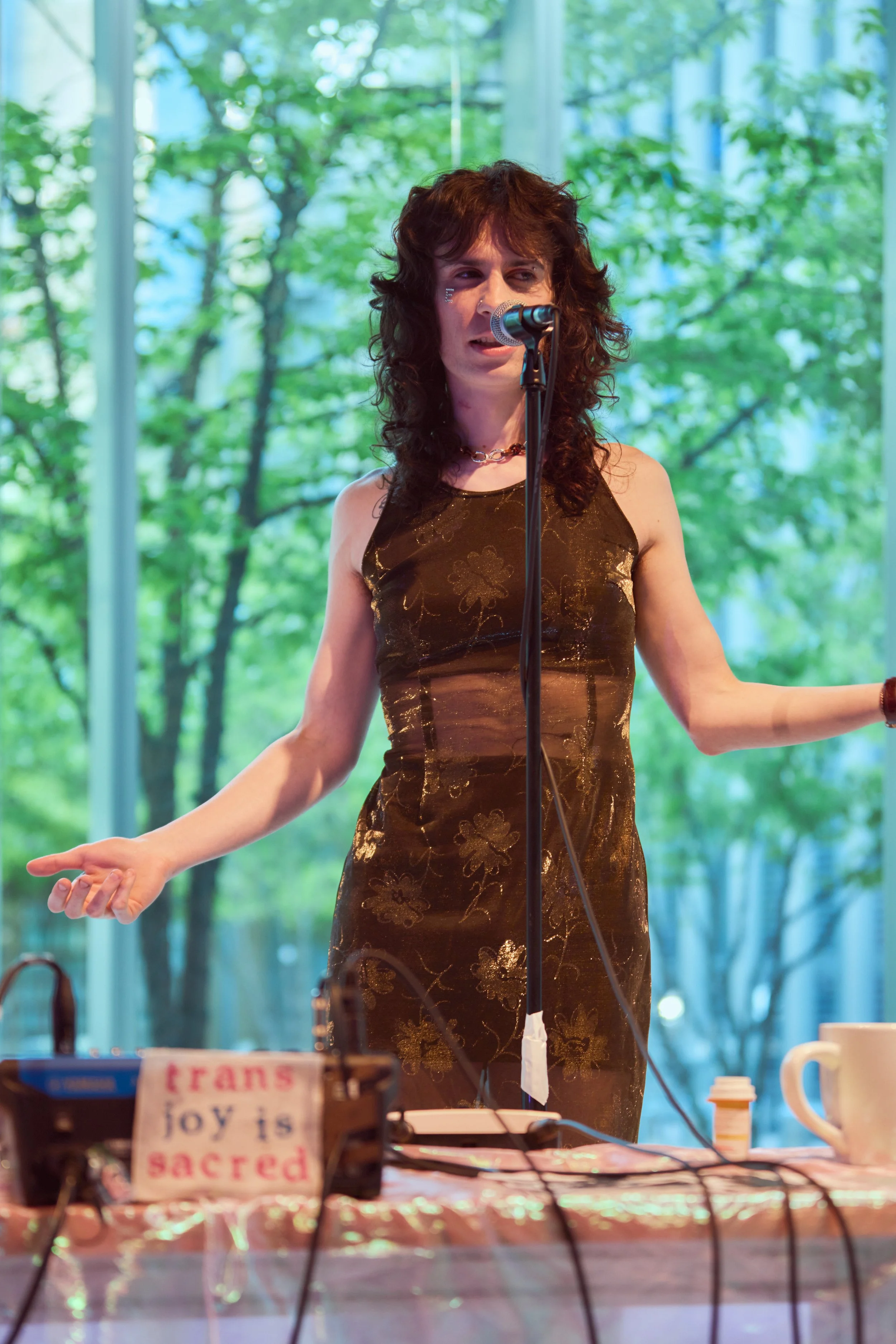
Photo Credit: Sarah Joyce / GlitterGuts
What is the first transmission you received that altered your understanding of language?
I love your language of poems as analog transmissions, sending signals. Some of the early poets that landed for me in college were Bhanu Kapil, CAConrad, Mei-mei Berssenbrugge, and Renee Gladman. These were formative sources—writers who write into the body’s unknowing, often with ritual as a guide to draw out an unfamiliar world.
I also feel fortunate to have found and connected with other trans femme poets when I was in college, including Chrysanthemum Tran and Travis Alabanza, who was breaking through as a slam poet when I was studying abroad in London, and whose performances from the chapbook Before I Step Outside [You Love Me] I received as explicit permission and encouragement to follow my gender nonconforming intuitions. Another signal: finding a rare copy of kari edwards’ out of print poet’s novel a day in the life of p the week I started hormones. I performed some of the poems I wrote under her influence at a tribute event for her in San Francisco at the Lab, organized by Small Press Traffic.
In what way does transness tune/re-tune the craft choices you make?
Writing for me is often an experiment in écriture (trans)féminine_._ By naming écriture féminine_,_ the deconstructionist philosopher Hélène Cixous sought not so much a definition of women’s writing as a directive to seek out the “unheard-of songs” of our bodies: “a world of searching, the elaboration of a knowledge, on the basis of a systematic experimentation with the bodily functions, a passionate and precise interrogation of [our] erotogeneity.” Following this prescription, I write max-embodied syntax, attuned to language as a mutable and creaturely medium, a body like mine subject to time’s alchemy.
In my book E (Nightboat Books, 2026) I turn to mishearing as a mode of rewriting or remixing missed sounds to make an alternative world, fundamentally embracing change as sacred. This process feels trans in its treatment of sound and language as unfixed, reclaiming glitch and slippage as fecundly generative. My echodeviant “alter-book” remixes fragments from Louis Zukofsky’s “A,” which was a poem of a life published sequentially in 24 movements across five decades, in order to give voice to my own experience of my shifting body in my first five years on estrogen. Zukofsky was an American modernist Marxist poet known for homophonic translation which prioritized the mouthfeel rather than the meaning of poems he translated. This form became my vehicle for mishearing, and like a game of telephone, I kept passing my echoes around drafts over time, replacing phrases with further removed soundalikes as the poems gradually became itself and forgot its original source “assigned at berth” (e a r asure?). In this gradual intuitive evolution, my poems become timestamps of my body’s iterations.
Early in my transition and early in the process of drafting what became this book, I made a video performing several poems from it. Revisiting the video even a few years later, it felt archival almost immediately. I felt a jarring, though not dysphoric, sense of distance from seeing earlier versions of my body (blue hair!) and poems which had since evolved, and experienced a sense of contrast in my own lived experience. I no longer felt like I could screen the video without some kind of live intervention to give audiences who did not know me previously—neither my past selves or my current self—a sense of the time travel careening I felt. So I performed a silent ritual in front of the video projection, taking a pill of estrogen in sync with my past self on video, then going on to read more recent poems. That reworking allowed for a dialogue between past, present and future, a palimpsest exposing transition as a living and unfinished process without destination.
If your work could transmit beyond this moment, to future readers, or even back to a younger version of yourself, what would you want it to carry?
I did not know any openly trans people growing up in a suburb north of Los Angeles. I did not have trans mentors who could provide advice or provide a picture of what my future might look like. Beginning again as an adult was a strange and humbling experience, and I am grateful for the people who make up my very trans-centered world now, including friends, lovers, sisters, siblings, collaborators, mentors, muses, and very often a mix of those slippery roles. Chosen and found family is what grounds me and guides me. It makes my life vibrant and full of worth, excitement.
My message is to seek out and prioritize connections and collaborations with other trans people, especially across generations, which I’ve learned opens up unpredictable horizons of possibility for emergence and expansion. Encountering different lived experiences and vocabulary reminds me that transness has never been a singular thing and varies by place and time. For me, “T4T” (which I have stick-n-poked on my left wrist), is a commitment—not a sexual orientation, but a practice of centering trans relationships in my everyday life. I’ve experienced a trans-centered education of unlearning and relearning from book groups and writing workshops like TC Tolbert’s Trans/Space (a generative virtual space staggered in age and geography), making zines with friends, editing poetry for the trans youth literary magazine Chrysalis, and also from experimenting in specifically queer underground social worlds like nightlife or camping.