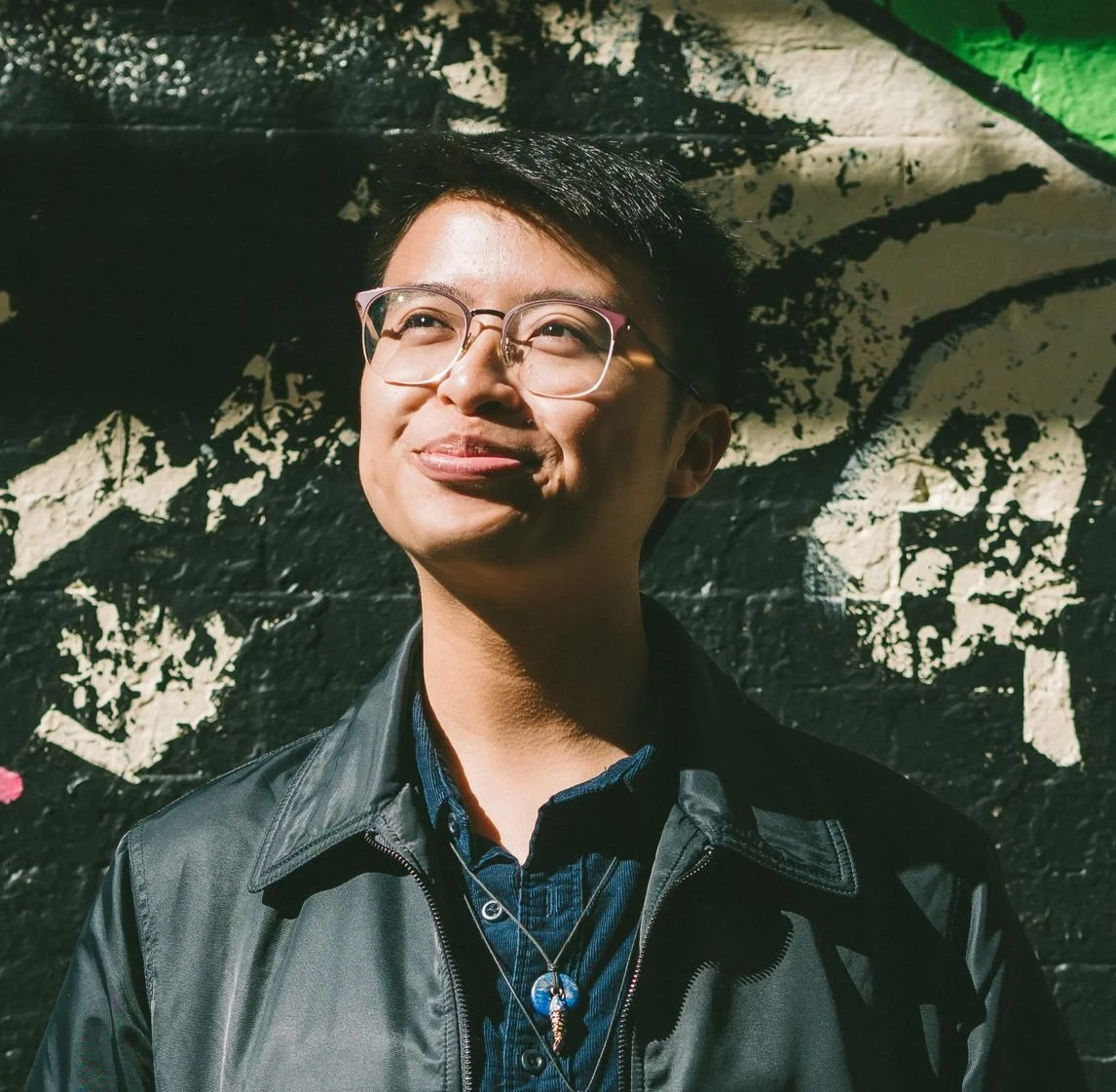
River 瑩瑩 Dandelion (he, him, keoi 佢) is a poet, educator, and healing arts practitioner. He writes to connect with the unseen and unspoken so we can feel and heal. River is the author of remembering (y)our light, a poetry chapbook which was a finalist for the 2024 North Street Book Prize. He won the 2024 Lambda Literary Award for Exceptional New LGBTQ Writers. River holds an MFA in Creative Writing from Rutgers University—Newark, where he served as a Chancellor's Graduate Fellow and taught undergraduate creative writing. He has received fellowships and residencies from Baldwin for the Arts, Banff Centre, Headlands Center, Kundiman, Lambda Literary, Tin House, Ucross Foundation, Vermont Studio Center, and beyond. He has taught and presented at New York University, Rutgers University, Dodge Poetry Festival, Kripalu Center, Restorative Justice Initiative, Wellesley College, and more. River is at work on his debut full-length poetry collection on self and collective remembrance. He loves to swim, and does this work for trans and queer ancestors and descendants to come. For more, visit riverdandelion.com.
What is the first transmission you received that altered your understanding of language?
i was raised by my grandparents. my grandfather, my 公公, picked up my sister and i from school, and took care of us. cooked for us. his food, congee, udon noodle soups were the first transmissions i received. of our people, our culture, of whom and where we come.
my grandfather spoke to us in Toisanese. i grew up in New York's Chinatown, where I heard Cantonese, Mandarin, Toisanese, and Fujianese. my world, since young, was multilingual. and it is because of this, my writing is too.
my grandfather modeled for me a masculinity rooted in care, softness, and tenderness. this fundamentally shapes my transness to this day. he was a man who sang songs of his generation while he cooked. took on his retired life in the domestic realm. because of this, my poetry, too, is rooted in love and care. even the angry poems, and the ones written after loss.
my grandfather was a man who did not speak English, but taught me the English alphabet. my cousins and i attest to this to this day. he sat down with each of us at the kitchen table, and taught us how to write, shaped our handwriting to be beautiful, what he knew we could create. his love, his care was one of the first transmissions i received, and one i continue to proudly carry.
In what way does transness tune/re-tune the craft choices you make?
transness is a gift that allows me to see the world in its wholeness, in its totality. embodying transness allows me to reject society's rules and conventions, and instead, to self-determine the world as my own.
i took a writing workshop once with Leah Lakshmi Piepzna-Samarasinha, who encouraged us to embrace our neuroqueerness, and write neurodivergently. to embrace the idea that our writing can happen in our own time, on our own terms, and not look like anything we have known.
transness allows me to craft my work with conviction and love. to root my stories in myself and my communities. transness roots me with my ancestors: the transcestors, humans and sea life, the whales who call to me, call back to me across time and generations.
transness allows me to make and remake tradition. as a trans person of color, of the Toisanese diaspora, i carry a lineage of trans people who have come before me. a lineage of trans people who got to live their lives boldly and proudly, and the ones who didn't, but still fought for lives of dignity. transness allows me to see and recognize that my work is part of a greater collective. my writing exists within and beyond myself. and serves all of us.
transness is my inheritance, my gift, my blessing. it is because of this that our government wants to make being trans a living hell. we won't allow them to. because we have ourselves, our spirits, and each other. rooting myself and my work in transness allows me to be in my full dignity, to be in my most immaculate and exquisite dreams. transness is my birthright. and it is inside of this truth, this knowing, that my craft, my work, shines.
If your work could transmit beyond this moment, to future readers, or even back to a younger version of yourself, what would you want it to carry?
i want my work to carry flowers. for my future trans readers, and for all my past selves. i want my work to be the balm, the salve, the assurance that even when your inner world feels like it's ending, there is hope, a glimmer, a bastion for the future. that even when we feel anomaly and ahistoric, i want my work to counter that. to help us remember that we come from somewhere before these colonial times, before empire. this is a knowing that even if sometimes we cannot name, still lives in our body, our cells, our DNA.