

Isaiah saying goodbye to his room, Ocean Hill, New York, 2022 by Yuhan Cheng
Classical Saree (translated by Quamrul Hassan)
Translator’s note
I met Umma Habiba at a reading in Dhaka after her book Ghashe Ghashe Roktoful (Bloodflowers in the Grass, 2022) was published. Soon I read a copy of the book, and it was such a mesmerizing experience that I felt like translating a few poems. I would go on to translate many more with the hope of having an entire book.
The title of the book appears in the last line of this poem, one that Umma penned while working in a coastal district in Bangladesh. Many times, the translator and the poet have similar feelings regarding a poem, but I have recently discovered that my interpretation differs from hers.
I interpreted the poem as a general representation of the trials and tribulations of a girl from a very humble belonging, who despite her situation never stops dreaming, although very often she ends up heartbroken. Umma likens the poem to her personal experiences and feelings. She says she penned the poem when she was experiencing an unrequited love.
Umma has used very powerful imagery to express the inner turmoil of a girl in love and on that, I believe we would all agree.
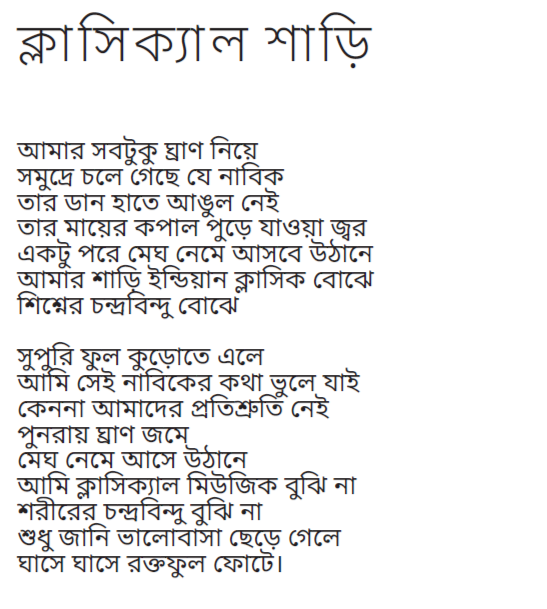
Classical Saree
translated from the Bangla
The sailor who stole all my aromas
And left for the sea
Has no fingers on his right hand
His mother is high on fever
Soon the clouds will come down on the yard
My saree knows Indian classical music
And the half moon on the tip of the penis
While collecting betel nut flowers
I forget about the sailor
Because we made no promises
Soon the aromas return
And the clouds come down on the yard
I don't understand classical music
I don't understand the half moon on the tip of the penis
All I know is that when love abandons you
You will see bloodflowers in the grass
—————
UMMA HABIBA is a poet and theater activist from Dhaka, Bangladesh. Her debut book of poetry Ghashe Ghashe Roktoful (Bloodflowers in the Grass) was published in 2022. Umma is also a development professional and has worked with Rohingya refugees, children with special needs, and the underprivileged indigenous people in the country’s hill tracts.\
QUAMRUL HASSAN is an MFA candidate at the University of Arkansas Program in Creative Writing and Translation. His poems and translations have been published in AGNI, Copper Nickel, The Malahat Review, Columbia Journal, Mantis, World Literature Today, Los Angeles Review, Tupelo Quarterly, Usawa Literary Review, and Star Literature Review.