Flash Truth: Swarm
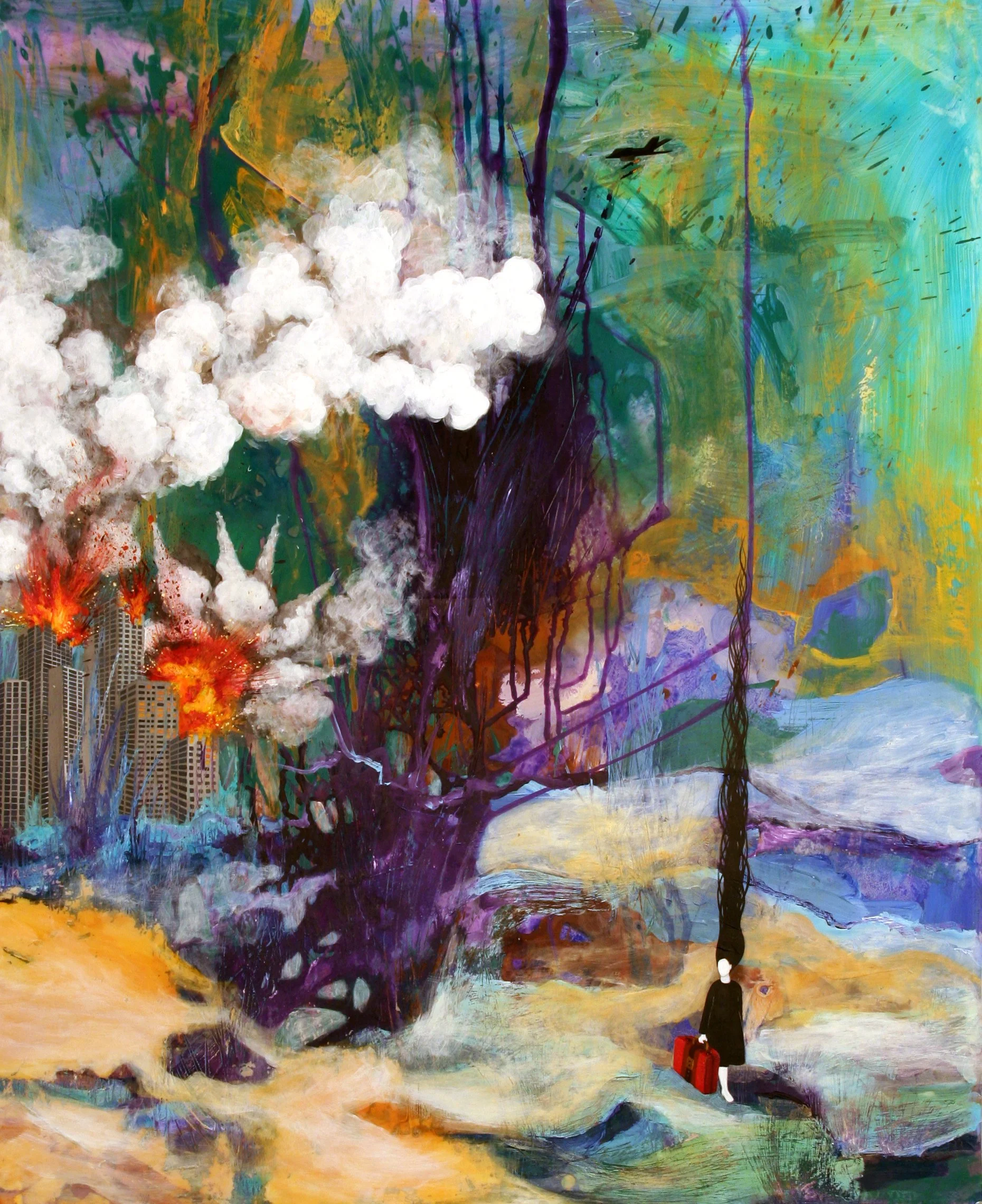
It’s Time To Go Home! by Hedieh Javanshir Ilchi
I am in the middle of thinking a simple thought when my mind shuts down; my body shuts down. I curl in on myself on the couch. If the room caught on fire, I could not roll over, move an arm. It’s like when I slept on our prickly loveseat in Oakland one afternoon: vividly paralyzed as the room continued awake around me. Mythic explanations said sitting ghosts. The woman who’d died before my boyfriend bought the house. Scientific explanations said an overlap of REM sleep and wakefulness. How it felt: my body as a stone in the bright river of the living room washing around me.
I am in the middle of thinking a simple thought, and my mind sinks, curling me in. Internet explanations say hormonal collapse. My estrogen has washed away in a snowmelt flood. My estrogen, in middle middle age, has washed away in the place of blood. My estrogen is like a colony of bees flown from their hive—blotting the sky-mind—anxious and chimney-brick-seeking, sweeping the hollow tree of my body for a dark cave to shelter.
I am in the middle of a river, which is made of streams and streams of bees. The bees are my younger selves, hungry to dance all night before lighting on the loveseat to read. Gold California afternoon through the windows like honey. I was in the middle of dancing; no, the middle of thinking, but I cannot move my arm. The room is on fire—like in The Princess Bride: flares appear here, here, there. Underfoot. Undercouch. Somewhere in the quicksand of my body.
I am in the middle of being Gen X in the middle of my life, acutely aware The Princess Bride is vintage, the couch I sink into is vintage. My thoughts are transparent as vintage Lucite or the lit tips of cigarettes I could not smoke now without my cells catching fire. I was in the middle of blending a smoothie, planning a class, answering emails, feeding the dog pills stuffed in cheese, but now I’m asleep like a fire must sleep when it’s burned to ashes, like maybe bees must sleep when they find a hollow chimney, the long, faded-velvet pea pod of this couch.
I am in the middle of a thought that is only my body sinking into this couch that belonged to a man who died, so his daughter posted it Free, so we, in our early thirties, drove to see, and it was beautiful and ’60s velvet and six feet long, so we paid $100 to rent a U-Haul and replace our prickly loveseat. This couch was free like aging is. I pay the acupuncturist $200 each month to stick needles in my knees-forehead-earlobes-scalp-stomach-toes-wrists, so my hormones will know which hive is theirs: not buzz my brain into a yellow, hot wing-storm. Or not do this as often.
I was wrong about the past-self ghosts sitting on me. I’m weighed down by my future. Other women said: someday you’ll be invisible. They didn’t say: you will be erased, crushed by no-more thought. The bright blank sky where the day was going to be.
I am in the middle of the day in the middle of a dream. The waitress has forgotten my pasta but brought too much, so I am hungry-full and refuse to take the box stuffed with leftovers. She says, You ordered it, and I grip her cheeks and squeeze, squeeze, squeeze like I’ve always done to people’s cheeks in anger dreams. Like I would never squeeze a person’s cheeks in waking life: bizarre and aggressive, like having hands made of pliers that are also bees.
I am in the middle of losing control of my life and searching for words. Bees, I say. Couch, I say. Estrogen curls in my mind, blows off like dry prickly leaves before I can catch it.
I am in the middle of the mixed metaphor of my life. My thoughts are sitting ghosts. My body is an arsonist. I could not move if the house burned to the ground, I think, but my house already really did that when I was a child. We didn’t have a chimney, so there wasn’t one after, just charred walls, blackened furniture, a few rough husks of books. To the ground is just an expression. Like middle age. It means you can see some ground, but it’s not the ground that was there before the fire, and no one’s rebuilding. That ship has sailed. Though it wasn’t a ship. Just a canoe shaped like a pea pod, and you’ve ridden it down the river of your life to this inevitability, this uncertainty.
I was in the middle of walking across pool concrete years ago and stepped on a bee, which stung my wet, bare foot. For a while it hurt to walk, and then it didn’t because the body forgets itself over and over; the body keeps bodying and buzzing and.
I was in the middle of being a child, before the fire, when I went with my journalist father to interview a beekeeper. She was blind and old and seemed so magic that for years I’ve wondered if I only dreamed her: the yellow sunlight through the curtains in the kitchen of her Texas farmhouse more vivid than anything waking. The light she could only see by touch. The bees she could only hear. Outside, those boxes: rustling, living, thousands of identical, not truly identical beings she conducted like electricity.
Anything can trigger an absconding swarm: lack of food, loud noises, overheating, odors, predators, the presence of chemicals. A swarm that makes a hive move suddenly from home like my father’s mind moves off, mid-conversation now, word by word. Flying into the sky when he speaks to me because he is twenty-five years older and losing his memory, so I cannot ask him—I will never be able to go back and ask him—if that woman was real.
I am in the middle of being a real woman who has lost her old real shape; who is shape shifting into stone-in-river-of-yellow-velvet. Woman caring for invisible bees. I have forgotten my gloves again. My arms are so stung I can’t move them. My face is creased with lines because my collagen has flown with my estrogen, and the couch cushions have lost their nap as they’ve faded from green to mustard to honey.
It’s a myth, I read, that if a swarm of bees chases you, you should jump into water to escape. Most swarms are not personal. Most swarms are like a moving van with many small, determined wings. But if they are swarming you, they will wait—stingered as dreams, as hormones, as time—above the water.
The bees pinch the cheeks of the sky.
They cast away from every shape they know.
They carry themselves molecule by molecule.
They are in the middle of a story they can only tell by flying.
They look like smoke—like creatures buffeted by tiny, hot circuits of biology.
—————
ALEXANDRA TEAGUE is the author of the poetry collection [ominous music intensifying] (Persea, 2024) and Spinning Tea Cups: A Mythical American Memoir (Oregon State University Press, 2023). She is the author of three prior books of poetry and a novel, as well as co-editor of Bullets into Bells: Poets & Citizens Respond to Gun Violence. She is a professor of creative writing and chair of English at University of Idaho.