Breadcrumbs
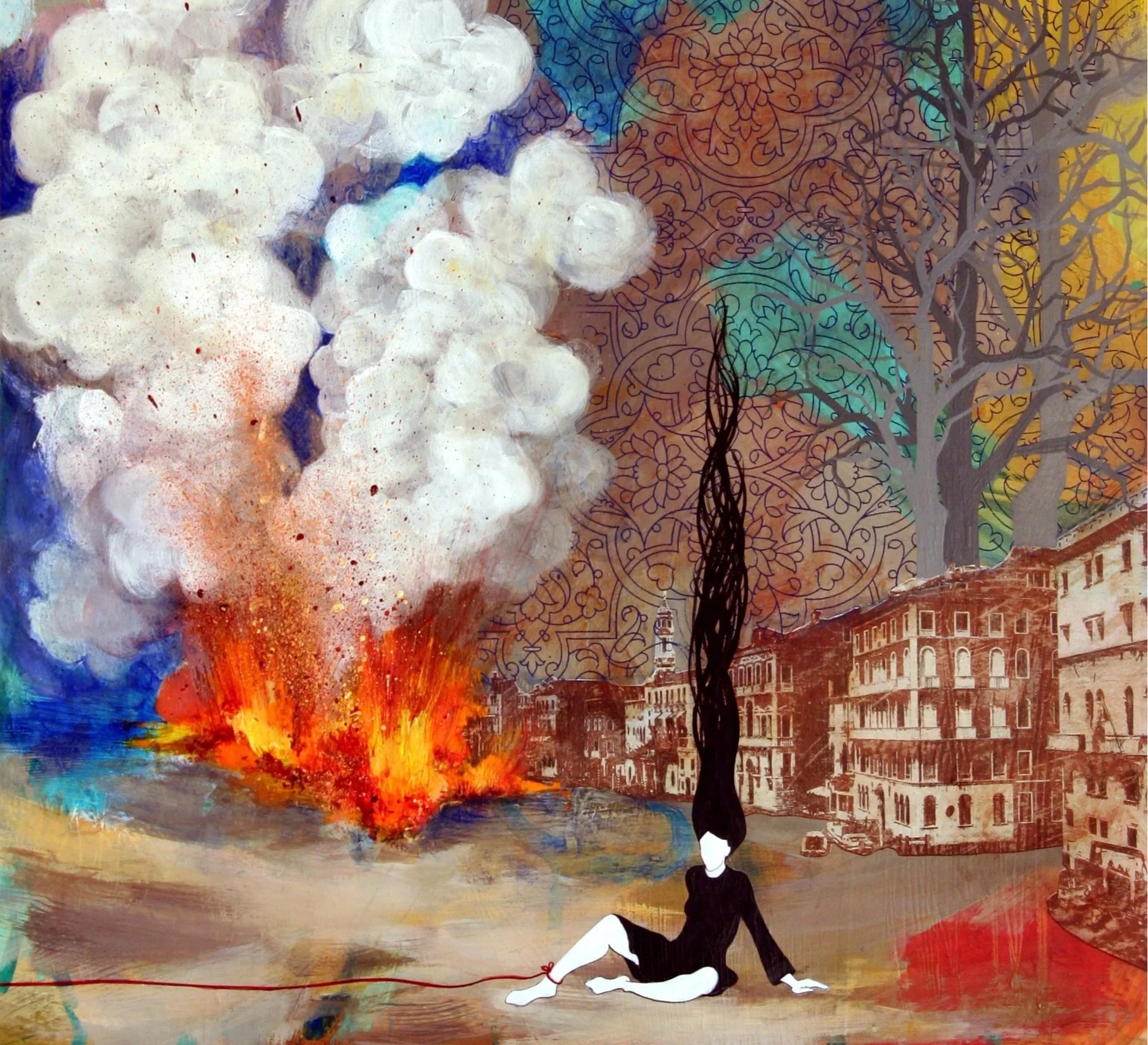
Too Bad, You Let Me Go by Hedieh Javanshir Ilchi
My grandfather used to leave me trails of breadcrumbs. He would exit the
house holding a loaf of bread, dropping crumbs behind him. I would follow at
a distance. These journeys took us all around my grandparents’ property, which
was separated from the beach by a thicket of bushes and trees, wherein lay
paths to the shore and to other houses. Sometimes we trespassed on the lawns of our neighbors, but we were never caught. When we reached a stopping place—a stump, an abandoned tree house, a rock garden—my grandfather would leave me what remained of the loaf, then depart without a word.
This game began, with no explanation, the summer I turned seven. Back then I had a problem with eavesdropping and sneaking into places where I was not welcome. I was always at my worst when we went to visit my grandparents at their house by the beach. There I could spy on all my relatives easily, for it was a big house, full of good hiding places. Still, I was almost always discovered in the act, and was consequently a source of embarrassment to my parents and a nuisance to the rest of the family. I believe that my grandfather invented this game to keep me occupied—he saw that I was sometimes left out, being the youngest of his seven grandchildren, and thought that some attention on his part could keep me out of trouble. He always had sympathy for the youngest; he had been the youngest himself. But since we never spoke of this before he died, I will never know.
This tradition ended the summer I turned eight, on a day I remember vividly. It may have been the hottest day of the season; soon a storm would break the heat. That day I saw my grandfather leave the house quietly, holding no loaf of bread, dropping no breadcrumbs behind him. I was curious, so I followed him anyway. He opened the door of the screened-in porch and walked across the grass towards one of the paths that went through the thorny bushes. Once he was barely visible through the green, I set out after him.
It was late afternoon, hot and dry, bright light glistening off the slick green leaves of the bushes. I set my foot down on the splintered boardwalk—first my toes, then, gradually, the rest of my foot. I moved slowly and steadily, making little noise. My grandfather proceeded through the bushes and didn’t look back.
When I was older, I learned that my great-grandfather, my grandmother’s father, imported unusual plants and trees from all over the world and surrounded the house with them. Back then, these mysterious old trees with twisted trunks loomed large above my head. Bushes with oddly colored flowers flanked me, hissing with hidden insects. My parents forbade me to walk on these boarded paths, since they were strewn with ticks, thorns, and poison ivy. My grandfather seemed to know them by heart, for he used them frequently and had many friends in the area.
My grandfather and I never spoke to each other of our journeys with breadcrumbs. We seldom spoke at all. He would sit in his study, behind spectacles and books, or surrounded by the strange and distinguished adults who were his guests. Sometimes he and I would encounter each other alone in one of the house’s long halls. We would stop and size each other up. He would mumble a few words to me in his deep voice, his brown eyes wide. I would say a few back, then we would continue on our separate ways.
Soon I was crouching low, my head near the thorns where I would sneak off with action figures to pretend they lived in castles among the branches. I ducked down and bobbed up, looking for my grandfather’s feet, then his torso, as he glided down the path like a ghost. Through the buzz of insects, the lapping of the waves, and the hum of distant speedboats, I heard nothing but the steady thump of my grandfather’s feet and the beat of my own small heart against my ribs.
Eventually my grandfather stopped. I peeked up at him from my hideout in the bushes. He stood at the base of an ascending dune, where the foreign bushes mixed with the wispy beach grass. Now the sound of the sea was louder, the smell of salt stronger. Before my grandfather lay a fork in the path, one side leading to a dock on the far end of the beach, the other continuing up the dune towards houses I had never seen. He took the second path.
Here the bushes faded into beach grass and the path, once curving and twisted, now proceeded straight along the ridge of the dune. I could see my grandfather in his entirety, head to foot, and we walked on sand instead of wood. I hung low so as not to be seen by people on my left—the grass was tall enough to conceal me from view. I assumed that everyone on the beach saw my grandfather from the waist up in his incongruous black suit moving through the grass.
Because I crouched so low I saw nothing but my grandfather for a long time. The afternoon light had started to wane. I started glancing behind me, wondering if I should go back, wondering when dinner was. I realized that we were not on my grandparents’ property anymore.
My grandparents’ house was old and spacious. It served as a gathering place for the family in the summertime, and I have many fond memories of haunting its closets and corridors when I was very young, of spending time on the beach with my cousins when I was older. But even as a child I was dimly aware of the hint of hostility in the air when my entire family was present. It was almost impossible to place. Very few visible arguments took place among the adults, and everyone’s attitude was friendly. It was not the absence of love; it was merely something that stood in its way. It surfaced behind closed doors, when feuds would fester over such trivial subjects as who got to sleep in what room. There were no actual confrontations. Instead, people approached my grandmother separately with complaints about one another, and she tried to make everyone happy. My grandfather sat behind his spectacles and took no notice.
My grandfather went down a slope ahead of me. I ran to catch up, hurrying down the tunnel of beach grass in the waning light.
The path ended before a drop off in the dune, almost like a cliff of sand. Straight ahead stood a house into which my grandfather disappeared.
This house was not unlike my grandparents’ beach house, not unlike many others in the vicinity. Shingles grey and weathered from the ocean air, white shutters, screen doors with black metal handles. Others tall and white with curved archways and shiny, golden brass knobs. Cotton curtains behind the windows.
And yet it was not my grandparents’ house. It was like looking down at silverware in a guest’s house—yes still a fork, but slightly off, not a fork as I have always known forks. A tall black weathervane stood atop the grey shingled roof. The sun was beginning to set.
Behind me, I couldn’t see the place where the path began, only the long corridor of seagrass. I looked at the deepening color of the sky. I thought of my mom. My dad. Dinner. A lone gull cried somewhere. A cormorant flew low, skimming the surface of the sea. My eyes turned back to the unfamiliar house. I continued along the path toward it.
Empty chairs sat on a porch overlooking the sea. Beyond stood a screen door that my grandfather must have walked through. The hot wood burned my feet. The hot metal handle stung my palm. I put my hand in my mouth to suck away the pain as I squeezed through the opening. The hinges were red with rust.
I stood in a pantry, much like the one in my grandparents’ house. But it was different. The fridge and stove were in different places. The window above the sink was smaller, only letting in a thin stream of light. My heart beat faster. I thought of my bed.
There was a sound above me. Footsteps, slow and methodical, my grandfather’s gait. I stood still. I heard my racing heart, the waves and the wind outside. He seemed to pass over me, then his steps grew quieter as he moved away. I went in search of stairs.
When I was older, I learned that all of us grandchildren were prey to a peculiar breed of restlessness. One cousin, four years my senior, used to steal signs that said “No Trespassing” and “Boathouse” from some particularly mean neighbors. They called my grandparents with complaints many times. My two oldest cousins often went streaking at night on the greens of the nearby country club. They were never caught. My sister kept snooping around in my grandmother’s make-up drawer, and though my grandmother was amused, my parents were not.
All seven of us, at some point, tried to sneak into the master bedroom, where my grandparents slept. Not only was it the largest room in the house, but it was almost always shut. Whenever we snuck in, we could inspect some old furniture—a mahogany desk, a porcelain lamp, the tallest mirror I have ever seen—and we were given access to a balcony that we could otherwise only see from the outside. These excursions had to be fast and furtive. The room was not demystified until my grandfather died, and my grandmother refused to sleep there ever again.
I turned the corner of the pantry to find a narrow set of stairs that led up to a long hallway with an oriental rug. A white door, slightly ajar, stood at the end. I approached it as slowly and quietly as I could, heel on the carpet first, then the rest of my foot. As I came closer, I heard murmurs. One voice was clearly my grandfather’s, the other I did not recognize. It sounded like a woman. I could not tell what they were saying.
The glass knob was level with the base of my neck. Voices, movement, and some laughter came from the other side. Still no audible words. The crack in the door was just my size. I slipped through it.
I found myself in the antechamber of a master bedroom, staring at old fashioned, green wallpaper. To my right stood a small dressing room with a white bureau and a gold rimmed mirror. To my left a white door also with a glass knob, left slightly ajar, identical to the one I had just passed through. This was all that separated me from what I heard—the voice of my grandfather and that of the mysterious woman. I couldn’t understand what they were saying. I tiptoed closer and peeked my head through.
My grandfather stood at the foot of a king size bed, completely naked except for a scuffed leather mask. In his hand he held something long and dark. He looked like one of my action figures.
On the bed lay a naked woman, much younger than he, but older than my mother. They could have seen me if they had merely turned their heads to the side, but they were watching each other.
What passed between them I did not yet have words to describe, save that it was fast and violent, and as soon as it started, I ceased to recognize my grandfather. I turned around and ran.
Once when I was very young, I threw sand in my best friend’s eyes. I did not do this maliciously. I did it to see what would happen. But when he began crying and my teachers chastised me, I felt such an overwhelming sense of guilt that I did not stop apologizing to him for weeks, and I asked my parents every night if I was evil because of what I had done.
It was this same feeling that seized me as I ran frantically down the path back to the house, only this time it was much stronger. The sun had almost set, and the path was now held in dim shadow. I was panting, I was tripping, I could barely see my way. But the image of my grandfather wearing the mask shone again and again in my mind, lighting the darkness like a flare gun, and I did not stop. Now, there was no avoiding the thorns and splinters, no avoiding the poison ivy and the ticks. I ran as though my grandfather chased me, breathlessly, apologizing with every step.
Sometime after the sun had set, I stumbled into the living room of my grandparents’ house, where the whole family, except for my grandfather, had gathered. I was panting, my legs were covered with scratches and bruises. I burst into tears.
In my room, my parents spoke to me alone and tried to get some answers from me—where had I been, why hadn’t I told them where I was going, what had happened. Every so often my sister would peek into the room, convinced that she alone could get me to talk, and every time my parents made her leave. I said nothing. Fixed in my mind was the image of my grandfather in the leather mask.
Eventually they gave up and simply let me cry. When my tears had subsided, they brought me down to dinner.
The hum of conversation came to an abrupt halt as I took my seat at the dining room table. I was starving. I didn’t realize how long it had been since I had last eaten, nor how fast I had run. I had just picked up my fork when I heard a deep voice come from the head of the table.
“Are you feeling better, Oliver?”
My grandfather was back, sitting at the head of the table beside my grandmother. Our eyes met briefly. I bolted from the room towards the beach.
I was watching the dark ocean rise and fall, wondering if I could swim my way back home, when my mother shined a flashlight on my back, and the waves briefly shone brighter than the rest of the night. She put her hand on my shoulder and we walked on the sand, picking up shells and putting them in a plastic bucket. When we were done, we sat by the shore and listened to the steady rhythm of the sea. Eventually, my breathing slowed, and my mother led me up to bed.
The whole house seemed to have gone to sleep as we walked down the hallway where the children’s rooms were. This section of the house had once been the servants’ quarters. Each room had a faded mirror and tiny sink that no longer worked. When we got to my room, we turned the light on. There, on the bed, lay a loaf of bread.
I took the loaf and hurled it against the wall. I was going to stomp on it when my mother grabbed me and told me to stop.
“What are you doing, Oliver? Crumbs are getting all over the floor. Here.” She picked it up. “I’ll throw it away.”
But then I seized the loaf of bread from her hands and begged her to let me keep it.
That night, I held it to me as I went to sleep.
—————
ANDREW PLIMPTON is a writer living in western Massachusetts. His stories have appeared in The Dalhousie Review, Heavy Feather Review, and The Write Launch. His plays have been performed at The Tank in New York City. He is currently working on a collection of stories and a full-length play.